
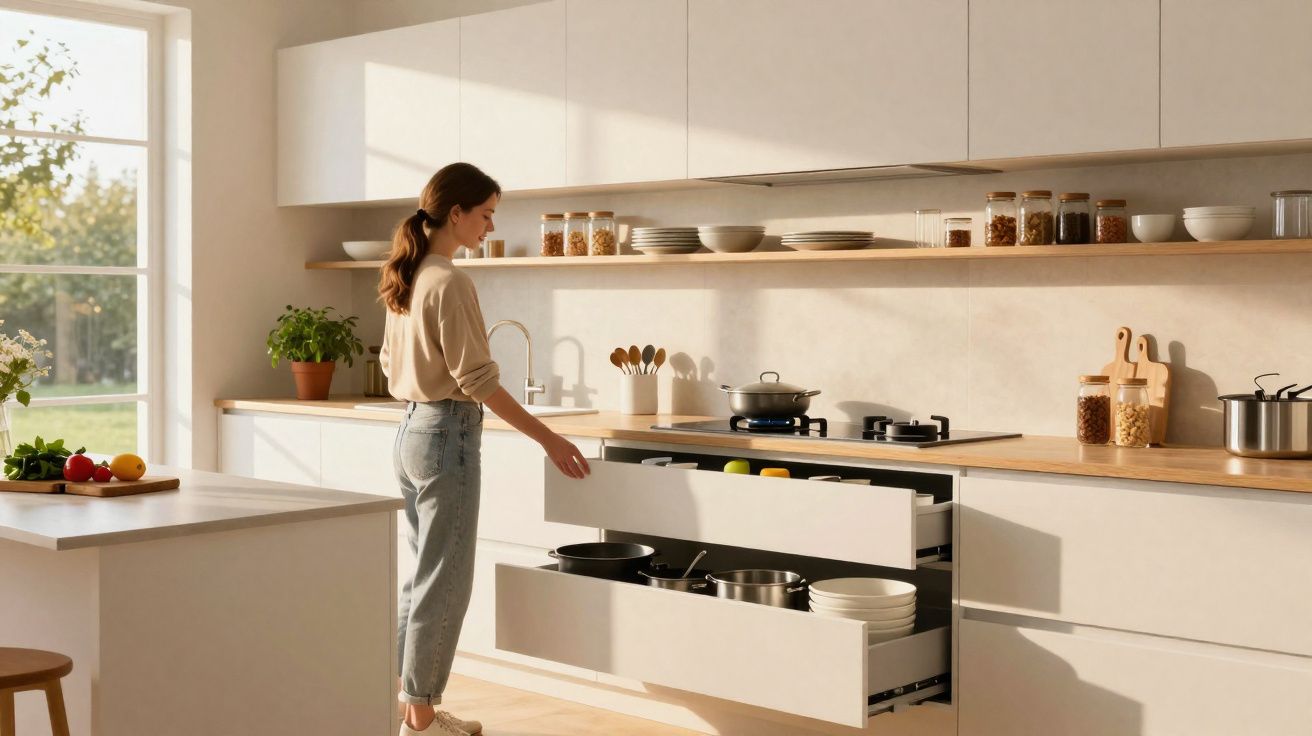
Kitchen walls are starting to look oddly bare, and that “emptiness” is no accident - it’s a look interior designers have been steering towards for quite some time.
The long-running fashion for tall overhead cupboards dominating the room is slipping away, swapped for a calmer, more functional approach that keeps storage without enclosing the space or stealing daylight.
Why high wall units are quietly disappearing from kitchen design
For years, the default logic in kitchen planning was simple: if you’re short on storage, go up. High wall units marched around the room, crammed with plates, tumblers and that fondue set that rarely (if ever) saw the light of day.
On a floorplan, it makes perfect sense. In day-to-day use, though, it often produces kitchens that feel dim and weighty. Wall cupboards cast shade over worktops, make compact rooms feel tighter, and turn the top shelves into awkward, semi-unusable territory.
The emerging trend keeps the storage, but gives your eye line room to breathe - replacing bulky high units with smarter deep drawers and carefully used open shelving.
Across Europe and the US, designers increasingly talk about the visual horizon: the uninterrupted line your eyes follow when you enter a room. Remove the overhead blocks and the kitchen typically reads as broader, quieter and brighter - even when the square metres haven’t changed.
Deep drawers and open shelving: the wall-units alternative that still stores everything
The most common substitute for classic high wall units is refreshingly straightforward: large, deep drawers (often described as pull-out basket units) teamed with slim, open shelves.
Think of the kitchen as a horizontal system: most storage sits below the worktop, while frequently used pieces and display items live openly above.
Deep drawers that genuinely do the heavy lifting
Modern base units can handle far more than older wall cupboards ever managed. Today’s drawers are available wide and tall, built to take serious weight, and often fitted with full-extension runners so you can see the whole contents with a single pull.
- Wide drawers for pans, pots and bulky appliances
- Medium drawers for plates, bowls and food containers
- Shallow top drawers for cutlery, utensils and spices
The biggest change is as much mental as it is practical. Instead of piling things into hidden vertical stacks, people are moving to horizontal layers where nothing disappears into the back of a dark cupboard.
Add internal organisers - boxes, dividers, plate racks - and suddenly every centimetre has a defined role. The knock-on effect is fewer duplicates and fewer “mystery corners” where food, cables and gadgets vanish for years.
Minimal shelving where everything stays visible
On the walls, the emphasis has shifted to narrow shelves in materials such as timber, metal or stone. Rather than closing the room in, they help outline it.
Shelves tend to hold what you want to see or grab quickly: daily glasses, mugs, oils, a couple of bowls, and perhaps a plant. The rest is kept out of sight in the generous drawers below.
Open shelves can make a kitchen feel complete without surrounding you with heavy boxes. Used well, they add character rather than clutter.
Designers do caution against treating every shelf like a dumping ground. The most successful schemes style shelves more like a living-room surface than a bit of garage racking.
More daylight, easier access, and less stretching
Dropping wall units isn’t only an aesthetic decision - it changes how the kitchen works in everyday life.
| With high wall units | With drawers + shelves |
|---|---|
| Top shelves are awkward to reach | Most items sit around waist or hip height |
| Worktops end up in shadow | Walls bounce more natural and artificial light |
| Can look bulky, especially in small rooms | Creates a lighter, more open feel |
| Items disappear at the back of deep cupboards | Drawers pull fully out, so nothing gets lost |
For older people, households with children, or anyone dealing with back or shoulder pain, the difference can be significant. You can put away the step stool, stop lifting heavy serving dishes above head height, and make daily cooking feel more fluid and less like a workout.
Can this work in a small kitchen or a rented flat?
Many renters - and plenty of owners of compact flats - assume wall cupboards are essential when space is tight. Designers often argue the reverse: smaller rooms can benefit most from clearing the upper wall area.
Even in a narrow galley layout, a run of low units with oversized pull-out drawers can provide more usable storage than a mix of small base cupboards and cluttered wall units.
If you’re renting and can’t fully refit the kitchen, a phased approach is common:
- Take down one or two wall cupboards and swap them for shelves
- Add freestanding drawer units or trolleys where the layout allows
- Upgrade existing drawers with stackable containers and organisers
Even clearing a single section of wall can make a striking difference - particularly near a window or around a dining spot.
What happens to the storage space when wall units go?
The obvious concern is capacity: if you remove half the cupboards, where does it all go? Designers often begin with a more challenging question: do you truly need everything currently stored up there?
Most kitchens contain more forgotten gadgets than real essentials. This approach forces a clearer, more honest audit of what you actually use.
Once the surplus is removed, the storage puzzle looks very different. A typical arrangement might include:
- Base units along one or two walls fitted with deep drawers
- A tall pantry or larder cupboard for dry goods
- One column unit for an integrated oven and possibly a microwave
- Two or three open shelves for everyday items and decorative pieces
The outcome is usually not less storage, but better storage - where each compartment has a purpose rather than becoming a general dumping ground.
Design choices that make drawers-and-shelves work
Planning the “working zone”
To keep this layout comfortable, plan in zones. Items you use daily should sit either on open shelves between waist and eye level, or in the top two drawers under the main worktop.
Heavier or occasional-use items can live in lower drawers or in a tall larder. Seasonal kit can move to a utility room or to a high shelf outside the main kitchen zone.
Balancing open and closed space
If you install too much open shelving, visual noise builds quickly. If you install too little, the kitchen can feel unfinished. Many designers concentrate shelves on one or two key walls and keep the rest clean and uncluttered.
Colour helps, too. Shelves painted to match the wall can almost disappear, while a contrasting shelf - timber or black metal, for example - creates a crisp design line without adding bulk.
Lighting and splashback planning (often missed at first)
When you remove wall units, you also remove the easy hiding place for under-cupboard lighting. A common fix is to use slim wall lights, integrated LED strips beneath shelves, or ceiling spots aimed precisely at the working areas.
It’s also worth thinking about the splashback. With more visible wall, materials like tiled panels, limewash finishes or a single slab splashback become more prominent - and can help the “visual horizon” feel intentional rather than empty.
Practical examples - and a few small risks to weigh up
Picture a typical 3-metre kitchen wall. Instead of base cupboards plus three or four wall units, you could have:
- Three wide drawer units at floor level, each with three drawers
- A short run of two floating shelves centred above
- A tall, slim pantry at one end
Plates, pots, storage tubs and baking equipment go into the drawers. The shelves take coffee cups, everyday glasses, a handful of cookbooks and a plant. The wall remains visible around them, and the room feels like it can breathe.
There are trade-offs. Open shelving collects dust and cooking residue more quickly, particularly near the hob, so it needs regular wiping - and you’ll want to be selective about what you leave on show. Fragile or rarely used items are often better stored in closed drawers, or in a glass-fronted cupboard elsewhere.
In homes with young children, it may be sensible to keep breakables out of lower drawers at first, or fit child locks. Deep drawers are brilliantly accessible - which is ideal for adults and very tempting for toddlers.
Related trends reshaping the modern kitchen
The move away from high wall units links to broader shifts towards minimalism, open-plan living and the kitchen as a multi-use room. With more people working from home, the kitchen often doubles as an office, bar, homework area and social hub - and the heavy, traditional “fully fitted kitchen” look can feel less compatible with that flexibility.
Some homeowners pair the drawer-and-shelf approach with other ideas: integrated seating that continues the line of base units, low sideboards that flow into the dining area, or movable trolleys that provide extra storage on busy days and tuck away when not needed.
If you’re planning a renovation in the next few years, many designers recommend a simple exercise: sketch your kitchen with no upper cabinets at all. Then add back only what you genuinely require - perhaps a tall pantry and a couple of shelves. Even as a thought experiment, it can reset how you think about space, comfort and the everyday rhythm of cooking and living.


Comments
No comments yet. Be the first to comment!
Leave a Comment