
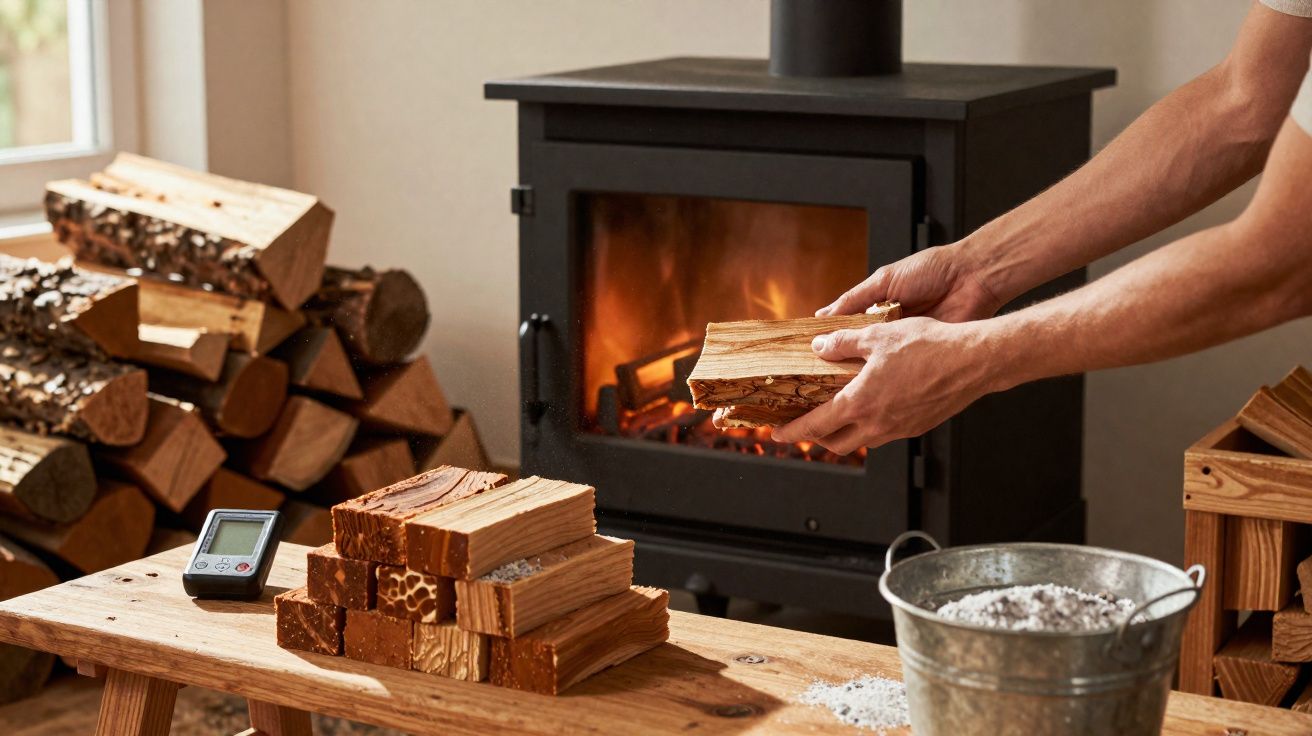
Many stove owners do not realise that an inconspicuous wood substitute can turn their appliance into a real heating powerhouse.
When people picture stove heat, they usually imagine metres of split logs stacked in a carport or shed. Yet specialists now point to a fuel made from compressed wood residues that can deliver up to three times more usable heat in a stove than conventional logs. For anyone trying to cut costs while keeping emissions in check, it is worth a closer look.
What compressed wood briquettes are made of
Compressed wood briquettes, often simply called wood briquettes or dense wood logs, are produced from sawdust and other wood leftovers from sawmills or the furniture industry. These residues are pressed together under very high pressure, without any added binding agents.
The result is a highly dense, uniform fuel with clearly defined properties. Ordinary split logs vary considerably depending on species, storage conditions and moisture content, whereas briquettes provide much more consistent performance.
The major advantage: up to 300 per cent more usable heating energy per kilogram compared with damp or only moderately seasoned firewood.
Because their moisture content is so low - usually below 10 per cent - very little energy is wasted on evaporating water during combustion. That is where the remarkable efficiency gain comes from.
Why the heat output is so much higher
High calorific value thanks to low residual moisture
Compressed wood briquettes typically achieve a calorific value of around 4.8 to 5.2 kilowatt-hours per kilogram. Well-seasoned split logs are more likely to sit in the region of 2 to 3 kilowatt-hours per kilogram, especially if they still contain 20 to 30 per cent water.
- Compressed wood briquettes: approx. 4.8–5.2 kWh/kg
- Traditional firewood: approx. 2–3 kWh/kg
In practical terms, anyone heating with briquettes needs far less fuel to reach the same room temperature. That difference shows up when ordering, carrying the fuel and, ultimately, on the bill.
Cleaner, steadier combustion
Because briquettes are so dense and uniform, they burn more calmly and evenly than many logs. They produce less smoke, fewer sparks and far less ash.
That helps to protect:
- the chimney, because less soot and fewer deposits build up,
- the stove glass, which stays clear for longer,
- your budget, because the appliance needs cleaning and maintenance less often.
Less ash, less mess, less effort - for many stove owners, that is the most welcome side effect of all.
Solving the space problem: storage in a small area
Anyone living in a town knows the issue: a single metre of split logs can quickly take over half a cellar or garage. Wood briquettes are far more compact and stack neatly.
Compared with conventional logs, you need only about a quarter of the storage space to achieve a similar heating output through winter. That is possible because the fuel is denser and contains more energy.
- Four times less storage space than many log stacks
- Supplied in handy packs, often wrapped in film
- Easier to carry and cleaner to handle
This is a major benefit for households without a large shed or garden. A few packs on a cellar shelf can be enough for several evenings by the fire.
Environmental balance: heating with waste instead of trunk wood
The briquettes are made from by-products of the wood industry that would otherwise often be burned or disposed of. By using them as heating fuel, a waste material becomes a valuable energy source.
Compressed wood briquettes make use of existing wood residues, easing pressure on forests and forestry.
Because the moisture content is low and the combustion is relatively complete, they generate less fine particulate matter and fewer soot particles than damp firewood. For anyone living in an area with strict air-quality rules, that can reduce the risk of problems linked to emissions.
How they compare with conventional log firewood
| Property | Compressed wood briquettes | Split logs |
|---|---|---|
| Calorific value per kg | approx. 4.8–5.2 kWh | approx. 2–3 kWh |
| Moisture content | < 10% | 20–30% (typical) |
| Storage space required | greatly reduced | very high |
| Amount of ash | low | high |
| Raw material source | wood residues, recycling | trunk wood |
How to use wood briquettes correctly
One point is often underestimated: briquettes need a certain amount of base heat before they really get going. Anyone treating them like ordinary kindling is likely to be disappointed. With the right approach, however, they work very reliably.
Step-by-step use in a stove
- Start with a strong fire using small, very dry kindling or natural firelighters.
- Wait until a good bed of embers has formed.
- Place one or two briquettes on the embers, not too close together, so air can move between them.
- Keep the combustion air open generously at first until the briquettes are burning properly.
- Then reduce the air supply slightly to achieve a long, steady ember phase.
It is essential to store them in a dry place. If briquettes are kept in a damp cellar or directly on concrete, they can absorb moisture and lose some of their advantages. A dry, well-ventilated room and a raised base, such as wooden pallets, help prevent that.
A simple stove thermometer or flue thermometer can be useful as well. It helps you keep the appliance in its efficient operating range, which protects the stove and makes better use of the fuel. It is also wise to check the manufacturer’s instructions, because some stoves work best with a particular loading method or maximum fuel amount.
What to look for when buying
Not every product is equally good. Quality can be recognised by a few key features:
- a light, even colour with no foreign material or visible plastic residues,
- a firm, stable shape that does not crumble as soon as you touch it,
- information about moisture content, the source of the wood and the production process,
- ideally certifications or test marks that point to controlled quality.
Sales channels are wide-ranging: DIY stores, fuel merchants, agricultural co-operatives and many online suppliers. If you buy in larger quantities, you can often negotiate a better price - and despite the higher price per kilogram compared with split logs, it often still pays off because the heat output is so much higher.
If you are buying in bulk, it is also worth asking whether the briquettes are made only from untreated wood. Clean raw material is especially important for anyone who wants low-emission heating and minimal ash residue.
Which drawbacks you should realistically factor in
There is no completely downside-free solution. Three points come up repeatedly in user reports.
Price, availability and handling
- Price level: The purchase price per kilogram is usually higher than for loose firewood. However, because consumption is lower thanks to the greater efficiency, the difference becomes much less noticeable.
- Regional availability: In rural areas with many woodland owners, conventional firewood is often more readily available. In cities, briquettes usually have the edge.
- Slightly more sensitive when lighting: Without a strong bed of embers, they are harder to get started than a quickly burning log.
Once people have found the right lighting technique, many users tend to stick with briquettes - despite the somewhat higher price per kilogram.
Who benefits most from making the switch
Moving entirely from a traditional log pile to wood briquettes will not suit everyone. Even so, certain groups stand to gain more than others.
- Town and city dwellers with limited storage space,
- people who do not want, or are unable, to lug around tonnes of wood,
- households with modern stoves designed for dry fuel,
- environmentally conscious users who value sensible use of wood residues.
Anyone with a very old stove and poor airflow, or someone who can collect wood almost for free from their own woodland, may see the extra cost more critically. For many others, a mixed approach is attractive: logs for long-lasting background heat and briquettes for quick, targeted heating spells in the evening.
Practical tips for everyday use with wood briquettes
A few small tricks can make daily handling much more convenient. Many users keep a box of loose kindling beside the stove, for example. That makes it easy to build a strong initial fire, after which the briquettes can be added.
It also helps to get to know the stove’s air controls again. Because briquettes burn differently from typical split logs, the stove and room temperature behave a little differently too. If you spend a few evenings observing how quickly the room warms up and how long the embers last, you will soon find a setting that suits your home and routine.
For homes with a heat-retaining stove, the steady burn of briquettes can be especially practical in the evening. They provide reliable warmth without constant refuelling, which makes them a good fit for relaxed, predictable heating.
In the end, compressed wood briquettes offer a compelling option for anyone who loves a wood fire but no longer wants to deal with semi-dry logs, heavy ash production and an overfilled wood store. For many households, this fuel could become the quiet star of the next heating season.



Comments
No comments yet. Be the first to comment!
Leave a Comment