
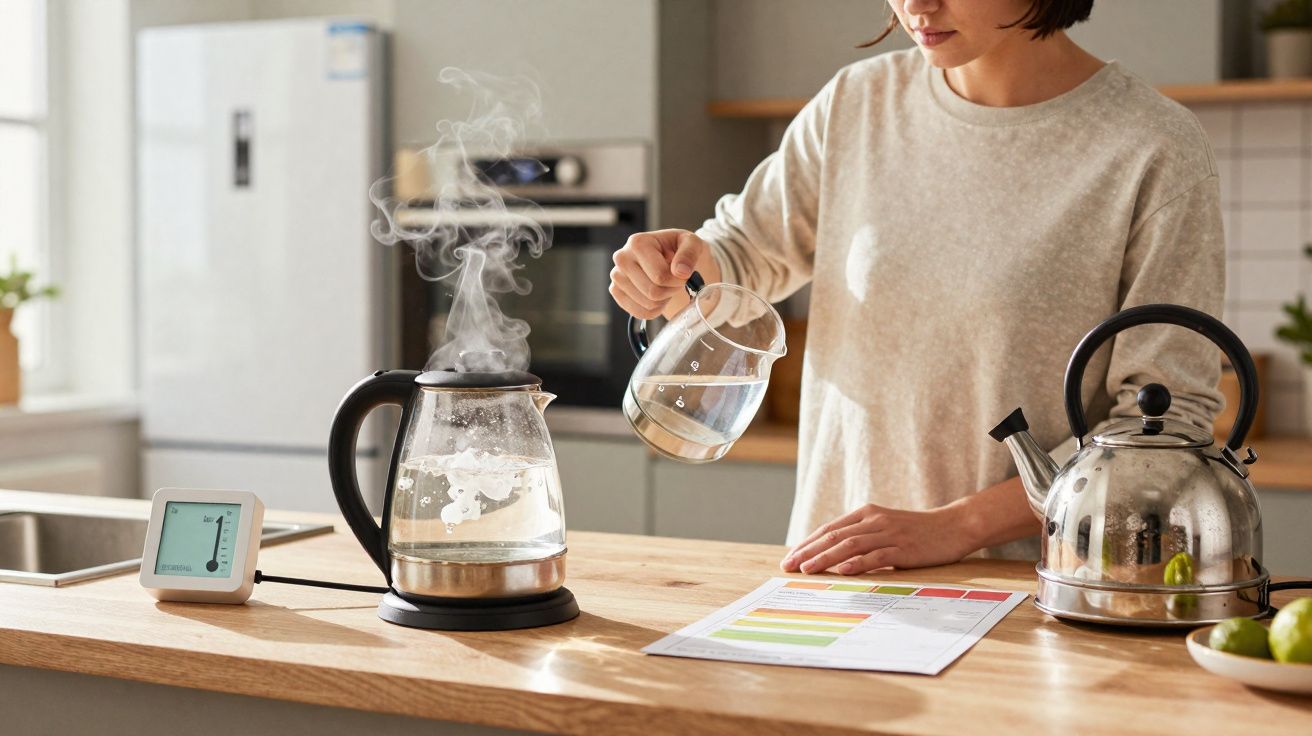
In almost every kitchen today, there is a device that is ready to work around the clock. It hardly makes a sound, barely warms up and appears completely harmless. Even so, it often pushes electricity bills up more than expected - in many homes, more than the oven, fridge or dishwasher when measured across a full year.
The underestimated power drain in the kitchen
That device is the classic kettle and its close relatives: the electric kettle, hot water dispenser or directly plumbed-in hot water station sitting on the worktop. In particular, modern convenience models with a keep-warm function or temperature selection often use far more energy than many people realise.
A kettle is one of the most powerful appliances in the home - 2,000 to 3,000 watts is entirely normal.
For a few cups of tea, that may not seem significant at first. The picture changes when the consumption is calculated over weeks and months - especially if the appliance is constantly on standby or keeps water hot for long periods.
Why the kettle uses so much energy
A glance at the rating plate reveals the issue: a kettle often runs at a higher power output than a modern oven. The difference is that it operates only briefly, but very frequently.
High power over a short period
A typical kettle has:
- Power: 1,800 to 3,000 watts
- Capacity: usually 1 to 1.7 litres
- Frequency of use: in many households, 5–10 times a day
That sounds harmless, but if you heat significantly more water than you actually need each time, you are literally burning money. Half a litre costs only a fraction of what a full kettle draws - yet many people still boil water “just in case”.
There is also another factor: many appliances have hidden keep-warm functions or remain on standby to power LED displays, temperature buttons or signal tones. This permanent readiness adds up, especially in households with several people or in home office setups.
If your household regularly makes several hot drinks in a row, it can also be worth using a thermos flask or insulated pot after the first boil. That avoids repeated reheating and keeps water at a usable temperature without the kettle cycling again and again.
Comparison with the oven, fridge and dishwasher
The oven, fridge and dishwasher are usually regarded as the big electricity users. On the face of it, that is fair. A fridge-freezer runs continuously, and the oven gets hotter than any other kitchen appliance. Even so, the kettle can surprisingly move close to them in annual consumption.
What many people overlook in the comparison
- Oven: Usually runs only a few times a week, but at 2–3 kW over longer periods.
- Fridge: Works all day, but in short bursts and at relatively moderate power.
- Dishwasher: Uses a lot of energy per cycle, but most households run it only once a day or less.
- Kettle: Many short uses every day - and often with far more water than necessary.
If you add up the use over a whole year, the kettle can easily end up in the middle range of kitchen appliances, depending on habits. In homes where tea is made constantly, or in office kitchens, it can even move into the top group.
The more often you need hot water, the more likely the kettle is to overtake supposed heavy hitters such as the oven.
How to tell whether your own kettle is costing too much
Anyone who wants a more precise picture does not need complicated equipment. A simple plug-in energy meter from a DIY shop or online retailer is enough.
Here is the process:
- Unplug the kettle from the socket.
- Plug the meter into the socket.
- Plug the kettle into the meter and use it as normal.
- After a few days or weeks, read the kWh figure shown on the display.
Using the electricity price per kWh, you can then work out how much money is going into hot water each month or year. Many people are surprised when they see the result.
How to reduce kettle electricity use
The good news is that this is one appliance where small changes in behaviour can deliver quick savings - without giving up convenience.
Heat only the amount of water you actually need
The biggest lever is simple: do not boil more water than necessary. For a cup of coffee, a little under a quarter of a litre is usually enough. Anyone who regularly boils a litre and then uses only one cup is wasting energy every time.
- Use the markings on the cup and fill the kettle with only that amount.
- Water for pasta or rice can sometimes be heated directly in the pan if it is going to be boiled anyway.
- Smaller kettles are often more efficient for single-person households than large 1.7-litre models.
Switch off keep-warm functions consistently
Many modern appliances offer a keep-warm mode: the water stays at 60–90 degrees for 30, 60 or even 120 minutes. It sounds convenient, but it is a constant electricity drain.
Anyone who:
- boils water fresh when needed,
- avoids appliances that hold a temperature all the time,
- and separates standby functions using a switched extension lead,
can cut annual consumption significantly.
Match the kettle to the household
Households vary widely in how much hot water they actually use. A family that makes tea, instant drinks and porridge throughout the day may benefit from a larger, efficient model, while a one-person household is usually better off with a compact kettle and a clear minimum-fill line. Choosing the right size from the outset can prevent years of unnecessary over-boiling.
Limescale, age and efficiency - what matters in the appliance
Alongside usage itself, the condition of the kettle also plays a part. A heavily scaled heating element works less efficiently because the layer of limescale acts like insulation. The water takes longer to boil, and electricity flows for longer than it should.
Regular descaling saves money
A simple mixture of water and household vinegar, or a standard descaling product, is enough to keep the kettle in good condition. As a rule of thumb: in areas with hard water, descale every two to four weeks; in soft-water areas, less often.
Every millimetre of limescale increases energy demand noticeably - and shortens the appliance’s lifespan.
Older kettles often lack a precise automatic shut-off. They continue boiling longer than necessary before switching off. Modern devices are usually more efficient here, provided they are not used with constant keep-warm programmes.
When it is worth buying a new appliance
If you are using a very old kettle, it may be worth replacing it. Useful criteria include:
- no automatic shut-off
- no boil-dry protection
- heavy corrosion or cracks
- a heating element that is permanently dirty or can no longer be descaled properly
A modern appliance with a clear fill scale, accurate shut-off and no unnecessary extra features often pays for itself within a few years. The important thing is not to choose every convenience feature that needs energy all the time.
Hidden effects in everyday life
The kettle is a symbol of a bigger issue: many small electricity uses seem harmless on their own, but together they can add up sharply. In households where coffee, tea or instant meals are prepared regularly, the short but intense power spikes quickly pile up.
If other major appliances are running at the same time - for example hob rings, the dishwasher or the washing machine - the household peak load can rise as well. In some tariffs with smart meters or time-based pricing, this also affects the bill.
Practical tips for the kitchen
If you want to reduce electricity costs, it is worth reconsidering several habits alongside the kettle. Useful approaches include:
- Use coffee machines with a thermal jug instead of a hotplate.
- Disconnect toasters and kettles completely from the mains with a switched extension lead.
- Use the kettle only for drinks, not as a permanent source of hot water for cooking.
- Check regularly that the heating element, contacts and lid close properly.
Combining several small savings creates a noticeable effect in the end. One cup of tea does not make much difference, but hundreds or thousands of heating cycles a year certainly do.
Why it is worth looking at your electricity bill
Rising energy prices make details like this increasingly important. If you take out your electricity bill and run through the biggest appliances in your head, the fridge, lighting and washing machine usually come to mind - the kettle rarely sits near the top. That is precisely why it slips into the role of the unassuming heavy user.
A quick check with a meter, a little discipline over fill levels and avoiding permanent keep-warm settings are usually enough to reduce consumption noticeably. If you also pay attention to descaling and regular care, you will ease the strain not only on the electricity bill, but on the appliance itself as well.




Comments
No comments yet. Be the first to comment!
Leave a Comment