
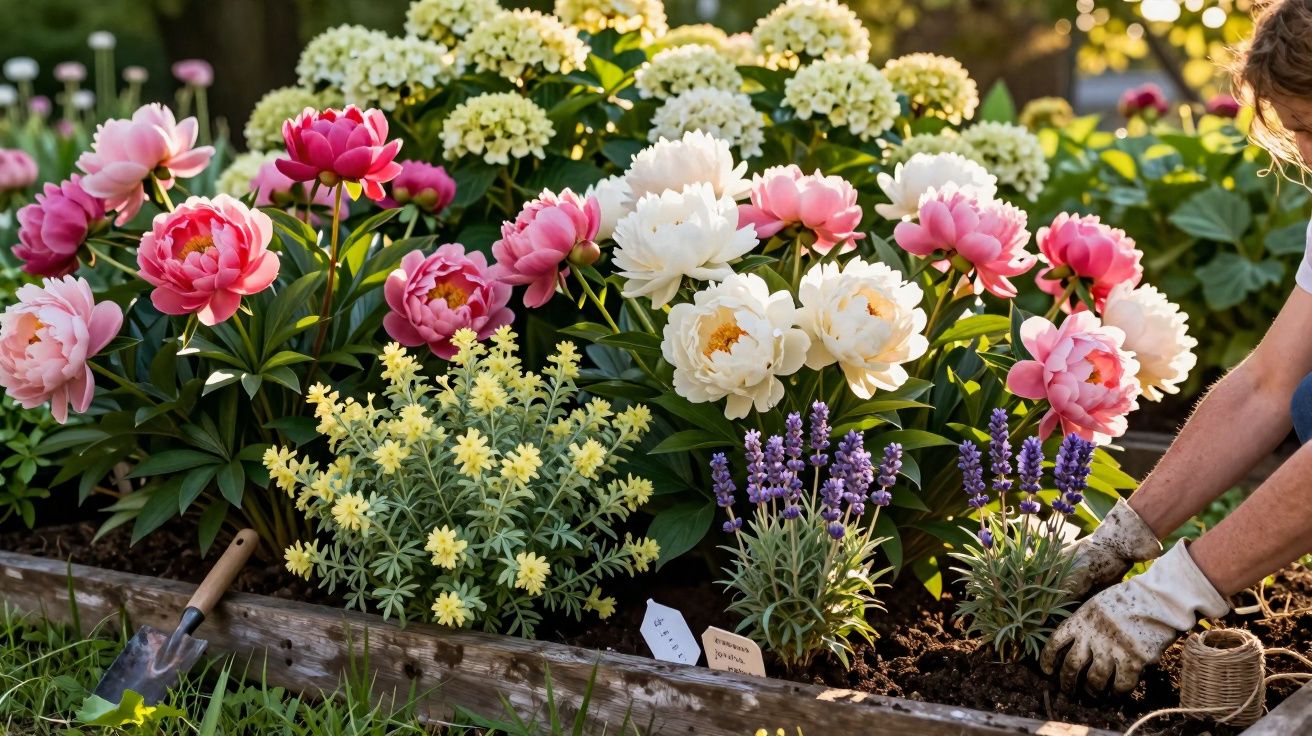
Many amateur gardeners are puzzled when their own peonies look lovely, but never quite spectacular. The flowers are there, yet the overall picture feels incomplete. That is where thoughtful planting combinations make all the difference: the perennials, shrubs and scented plants placed around a peony decide whether the bed merely looks pleasant or ends up resembling a painted scene.
Peonies also reward a bit of restraint. Once they have settled in, they prefer to be left alone rather than fussed over. A well-designed border, then, is not about crowding them with attention, but about choosing neighbours that enhance their form, colour and presence without competing for space.
What peonies really need before planting anything nearby
Peonies are among the toughest perennials in the garden. Once established, they usually ask for only one thing: to be left in peace. Even so, they have clear requirements that should be built into the border plan from the outset.
- Light: Full sun, or at most very light partial shade.
- Soil: Deep, humus-rich, and well drained.
- Moisture: Absolutely no winter waterlogging.
- Spacing: Plenty of air around the plant, with no congestion.
If the area around peonies is too tightly planted, moisture lingers for far too long. That creates ideal conditions for fungal problems such as the dreaded grey mould, which turns buds brown and can destroy entire flower trusses. In this case, overzealous tidying and planting too densely do more harm than good.
Peonies look their finest when they are given sun, space and free-draining soil - not when bulky rivals are crowded right up against them.
Before heading to the nursery, it pays to ask one quick question: does the planned neighbour suit the peony’s site and soil, or will it end up competing with the plant instead of complementing it?
The best border partners for peonies
Lady’s mantle: the quiet performer that makes peonies shine
One of the finest companions is Alchemilla, better known in British gardens as lady’s mantle. This sturdy perennial forms close-knit cushions of softly textured foliage. In early summer, a haze of yellow-green flowers floats above the leaves.
What makes it especially useful is the way its restrained flower colour helps the delicate pastel shades of many peonies glow even more brightly. Nothing clashes; everything appears as though it belongs together. In cut arrangements, too, lady’s mantle gives large peony blooms a light, natural framework.
Bellflowers and other perennials with nodding blooms
Perennials with bell-shaped flowers - including many bellflower varieties - fit beautifully into a peony border. They usually stay compact, do not surge upwards, and allow the heavy blossom heads of peonies to remain the focal point.
There is, however, one small drawback: some varieties are more vulnerable to pests. That does not mean they are unsuitable, only that they are best paired with “bodyguards” that help keep pests at bay.
Hydrangeas as a dramatic backdrop for peonies
If you want to set peonies off against a structured background, hydrangeas work well at the rear of the bed. Their large flower heads echo the rounded shape of peony blooms without overpowering them.
Distance matters here. Hydrangeas should not sit directly in the peonies’ root zone. Planted a little way back, they provide light shade during the hottest months without shutting out too much sun. They are best put into the ground from autumn through to spring.
A flowering sequence from spring to late summer
With careful pairing, a peony border can remain attractive throughout almost the whole season. A simple flowering sequence works particularly well:
- Before the peonies: Bearded iris, which usually put on their show shortly beforehand.
- Alongside the peonies: Lady’s mantle, bellflowers and alliums.
- After the peonies: Daylilies (Hemerocallis), which carry the display through summer.
This prevents dull gaps in the border. While the peonies fade, daylilies or hydrangeas quietly take over the leading role.
A useful extra idea is to think in layers of texture, not just colour. Peony flowers are full, rounded and theatrical, so they benefit from neighbours with finer leaves or lighter blooms. That contrast keeps the border looking deliberate rather than crowded.
Lavender as a scented shield: attractive and practical
Lavender is much more than a Mediterranean-style decorative plant. In a peony border, it plays two roles at once: it looks handsome and acts as a natural barrier.
Lavender likes exactly the same conditions as most peonies: full sun and free-draining soil. It is ideal for planting as a low edging along the front of the bed.
Lavender surrounds peonies with a fragrant barrier that puts off many pests - all without chemicals.
Its strong scent discourages a wide range of unwanted visitors, including:
- mosquitoes
- flies
- fleas
- clothes moths
- and often also deer, which prefer to keep their distance
Alliums, or ornamental onions, work in a similar way. Their eye-catching globe-shaped flowers fit in beautifully and also release a slightly sulphurous scent that many insects avoid.
Plants that should be kept away from peonies
Where there are dream combinations, there are also classic mistakes. Some plants simply do not suit peonies because they clash with their needs or dominate the available space.
| Problematic plant partner | Why it causes issues |
|---|---|
| Very tall, heavy grasses | Block light, crowd the plant, and spread aggressively |
| Plants that prefer persistently damp, heavy soil | Keep the area too wet and encourage fungal diseases |
| Shallow-rooted plants with aggressive root systems | Compete strongly for water and nutrients |
Peonies also need a closer look when they are combined with more delicate border plants. Bellflowers, for instance, can be prone to slugs or aphids, but they can still share a bed if they are flanked by plants such as lavender and allium, which act like a protective ring.
How to plan a harmonious peony border
A convincing border rarely happens by accident. If you follow a few basic principles, you can get the very best from only a small number of peonies:
- Start with the peonies: Decide where the main perennials will go first, then plan the companions around them.
- Think in height layers: Place peonies in the middle, lower plants in front, and taller ones set back at a distance.
- Allow for air movement: Leave a clear zone around each perennial so air can circulate freely.
- Choose colours deliberately: Pair pastel tones with soft green companions, and balance strong colours with calm foliage.
If you are uncertain, it helps to rely on straightforward combinations: pink peonies with lady’s mantle and purple lavender create an elegant effect, while white peonies with blue-violet bellflowers feel more classically romantic.
Another useful rule is to match the mood of the flower, not just the hue. A generous peony bloom looks best when surrounded by plants that either soften it or frame it gently. Harsh shapes and busy textures tend to weaken the overall impression.
Practical advice for care, cutting and long-term impact
Even the prettiest planting scheme loses its charm if peonies become weaker and less floriferous year after year. Three points determine how well they perform over the long term:
- Do not plant too deeply: The buds on the root crowns should sit only just below the soil surface, or flowering may fail.
- Do not move them constantly: Peonies dislike repeated transplanting. Once they are established in a good spot, they should be left there for years.
- Remove spent flowers: Cut off fading blooms promptly so the plant does not waste energy.
If you also choose healthy companions, you will often need very little spraying or heavy feeding. The combination of airy planting, free-draining soil and aromatic protective plants acts like a natural defence system.
In this context, a “companion plant” is one that supports a main plant visually, improves the local growing conditions, or helps keep pests away. It is not merely decoration, but part of a small living system within the border.
In practical terms, that means anyone buying new plants should look beyond the blossom alone and think about the role each one will play: backdrop, filler, scent barrier or colour partner. In a peony border especially, that kind of planning pays off for years, producing lush, almost theatrical displays.
A light layer of compost in spring can also help to keep the soil in good condition, provided it is not piled up against the crown. Good airflow around the base remains just as important as feeding, because peonies dislike being smothered as much as they dislike sitting in wet ground.
The key to an impressive peony display
If you want peonies that really stand out, the answer is not more effort but better company. Give them sun, space and well-drained soil, then surround them with plants that echo their shape, soften their colour or protect them naturally. When the planting is balanced, the border stops looking merely neat and starts looking unforgettable.


Comments
No comments yet. Be the first to comment!
Leave a Comment