
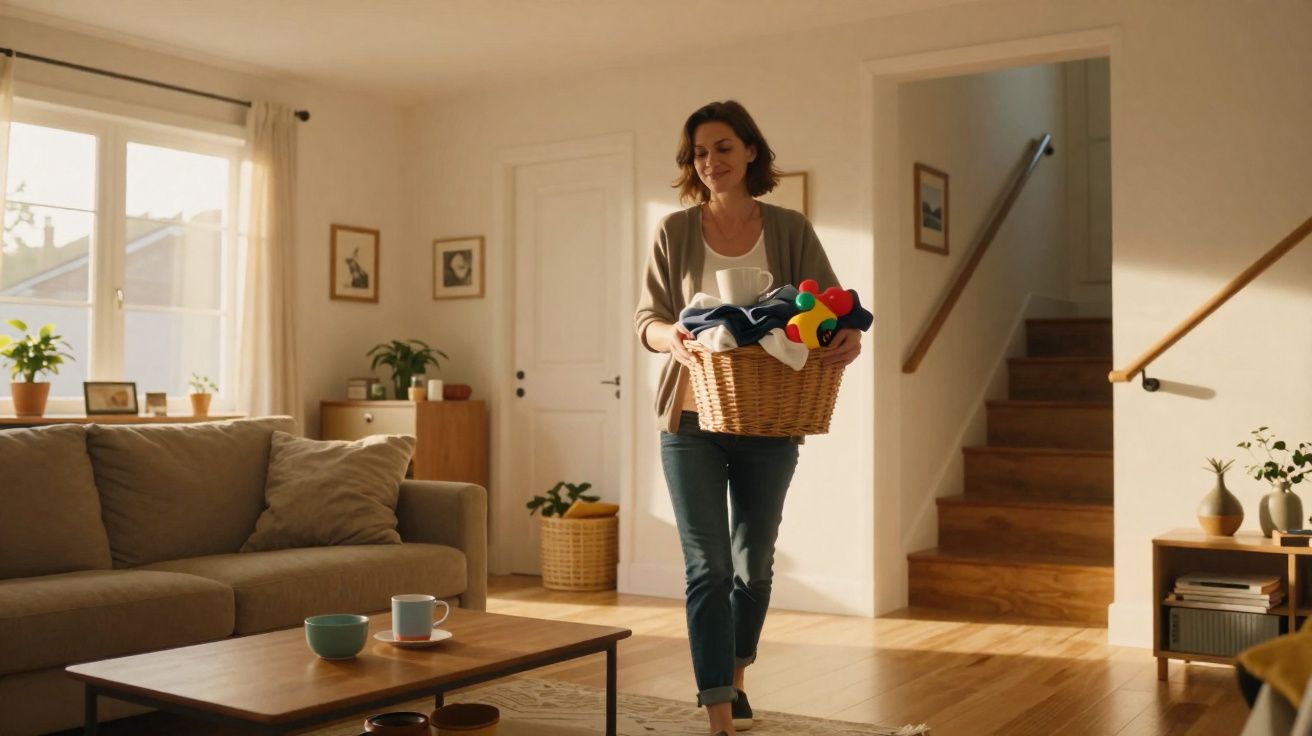
Monday evening, 20:47.
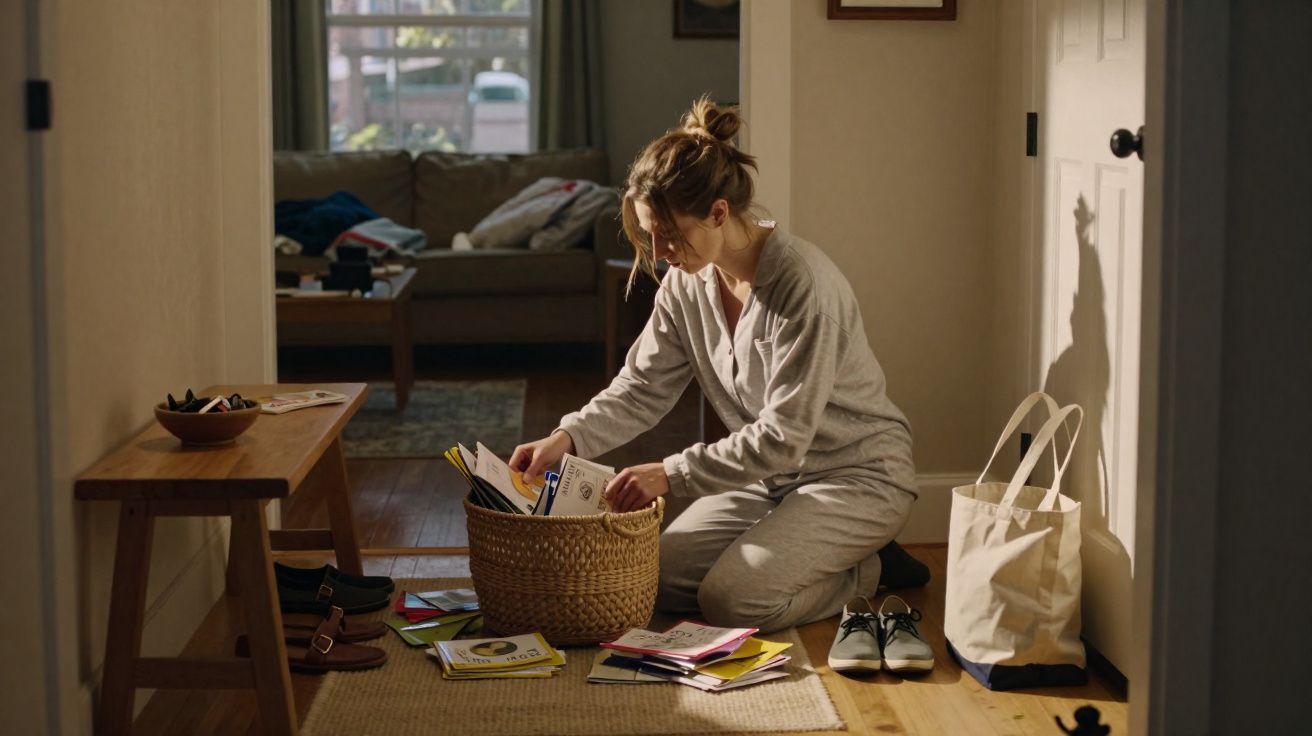
The dishwasher is whirring, the washing machine has just beeped, and you’re stood in the middle of the living room taking in the evidence: one stray sock, three half-built LEGO creations, and a rucksack that looks as though it’s survived a small-scale natural disaster. Only yesterday you told yourself, “This week will be different.” By Tuesday, you’re back to eating cereal out of a mug because every bowl is, once again, in the sink.
It isn’t laziness. It’s that you’re stretched thin, and when time gets tight, life has a way of spreading across every surface.
Sooner or later, one surprisingly simple habit starts to separate the homes that merely limp through the week from the homes that quietly stay workable.
And it probably isn’t what you imagine.
The quiet habit that stops a home from unraveling: never walk empty-handed
There’s something you start to notice when you step into a house that feels oddly steady-even on a day that’s clearly been hectic. It’s not necessarily that the owners have fewer belongings, or better storage, or children who instinctively put everything away. Their difference is in how they move around the house.
They almost never walk through the place empty-handed.
As they head from the kitchen to the hall, they bring something along. From the hall to the bedroom, something ends up where it actually belongs. It’s so small you can miss it entirely, but done dozens of times a day, this “one small thing while I’m already moving” approach works like a quiet, constant tidy-up happening in the background.
A friend of mine, Julie, has two children, a full-time job, and a partner who’s away a lot for work. On paper, her diary is chaos. Yet if you pop round on a Thursday evening, the place feels… not immaculate, but usable. There’s an actual chair you can sit on. There’s enough clear worktop to slice an apple without shifting five piles first.
She laughs when people call her “naturally tidy”. She isn’t. Years ago, she chose one rule: every time she crosses a room, she takes one out-of-place item with her. A toy sitting on the stairs gets carried up. A mug abandoned on the coffee table goes into the sink. Post left in the hallway gets dropped on the desk. By the time the kids are in bed, she’s done roughly 30 tiny resets-without ever setting aside time specifically to “tidy the house”.
This works because it relies on the one thing you do have during a busy week: movement you’re already making. You’re walking to the bathroom anyway. You’re going upstairs anyway. You’re passing the dining table anyway. That routine movement is essentially free.
Most of us plan cleaning in large chunks: “Tonight I’ll do a proper tidy.” Then you’re shattered, you end up scrolling on the sofa, and the plan evaporates. The “never walk empty-handed” rule bypasses motivation altogether. It doesn’t require the right mood.
It simply attaches itself to normal life-one item at a time-until the chaos quietly starts losing ground.
How to make “never walk empty-handed” stick as a real habit
Begin almost comically small.
Choose one route you take all the time: living room to kitchen, stairs to bedroom, front door to hallway. For the next week, whenever you travel that route, take one thing with you that’s heading the same way. Just one.
Getting up from the sofa to the kitchen? The empty glass comes with you. Going upstairs? Take the folded towel, or the book that’s been left on the steps. No armfuls. No “while I’m here I’ll reorganise everything”. One item, one trip.
The goal isn’t to transform your entire home in a day. The goal is to train your brain into a new autopilot.
Where people derail themselves is by trying to do too much too soon. On day one they decide they’ll carry five things each time they move, sort a drawer en route, and maybe straighten a shelf as well. That lasts until Wednesday-right before the late Zoom call and the child who suddenly remembers a science project due tomorrow. Then the whole system collapses.
And let’s be realistic: nobody executes this perfectly every single day.
So build in imperfection. Some days you’ll forget until the evening. Some days the only win is tossing a scrunched-up receipt in the bin. It still counts. This habit lasts not because you’re strict, but because you’re kind to yourself and you restart the next time you stand up.
If you’ve got limited mobility, or you’re caring for someone and can’t always carry items safely, adapt the rule rather than abandoning it. The principle is still “never walk empty-handed”, but “empty-handed” might mean wheeling a small caddy, using a lightweight basket, or doing a single “handover” to a safe drop zone (like the hallway table) for someone else to take upstairs later.
It can also help to decide what doesn’t qualify. If an item doesn’t yet have a proper home, the rule becomes frustrating. In that case, your “one thing” can be: choose a home for it (a drawer, a hook, a labelled box) so future trips stay effortless.
Homes that stay quietly functional aren’t run by superheroes; they’re run by people who automate tiny wins.
“I used to wait for a burst of energy to ‘sort the house out’. That burst hardly ever arrived,” says Marie, a nurse who works shifts. “Now I think, ‘What can I take with me since I’m going that way anyway?’ My home isn’t magazine-perfect, but I’m no longer standing on toy cars at 06:00. I’ll take that as a win.”
- Attach the habit to doorways – Each time you walk through a doorway, do a quick scan and pick up one item that’s travelling in the same direction.
- Use “landing spots” – A basket at the bottom of the stairs or near the hallway can hold upstairs or home-office items until your next trip.
- Keep it under 30 seconds – If it takes longer, it becomes a job rather than a reflex, and your brain will push back.
- Pick a personal mantra – Something short like “Never walk empty-handed” or “Take one thing” keeps the idea looping in your head.
- Count the invisible effort – At the end of a long day, notice the floor, table, or sofa. Quiet progress is still progress.
When “never walk empty-handed” starts to change how your home feels
A small moment usually arrives-often around the two- or three-week mark-when you realise something has shifted. You come in late, put your bag down, and you don’t get that immediate wave of defeat. The shoes are mostly where they should be, near the door. The table has breathing room. You can cook without relocating five random stacks first.
Nothing dramatic took place. You didn’t do a big “reset weekend”. You simply moved one item at a time along routes you were already walking. Gradually, the visual noise settles down. Your brain stops burning energy on constant, low-level stress.
You may also find there’s less bickering about chores. When things have been quietly drifting back to where they belong all day, there’s simply less mess available to argue over.
| Key point | Detail | Value for the reader |
|---|---|---|
| Turn movement into maintenance | Use each normal trip (stairs, kitchen, hallway) to take one item nearer to where it lives. | Cuts clutter without needing extra time or motivation. |
| Keep actions under 30 seconds | One tiny move per trip keeps the habit light and sustainable during busy weeks. | Makes tidying feel achievable even when you’re exhausted. |
| Use visual anchors | Baskets, doorways, and mantras prompt you to never walk empty-handed. | Helps the habit stick until it runs on autopilot. |
FAQ
- What if I’m already overwhelmed and my house is a disaster?
Choose one route and one item. Don’t attempt to “fix” everything at once. Give yourself a week of micro-moves before you assess what’s changed.- Does this replace regular cleaning or deep tidying?
No. It prevents day-to-day mess from snowballing, which means deep cleaning happens less often and feels far less miserable when it does.- What if my family doesn’t play along?
Start on your own, but say your mantra aloud: “I’m not walking empty-handed.” People often mirror what they repeatedly hear and see-especially children.- Can this work in a very small flat?
Yes. Short distances still matter. Taking a plate to the sink or returning a charger to its drawer keeps surfaces usable.- How long until I see a difference?
Many people spot a small improvement after 3–4 days, with a noticeable change in overall “home feel” after about two weeks of mostly consistent effort.


Comments
No comments yet. Be the first to comment!
Leave a Comment