
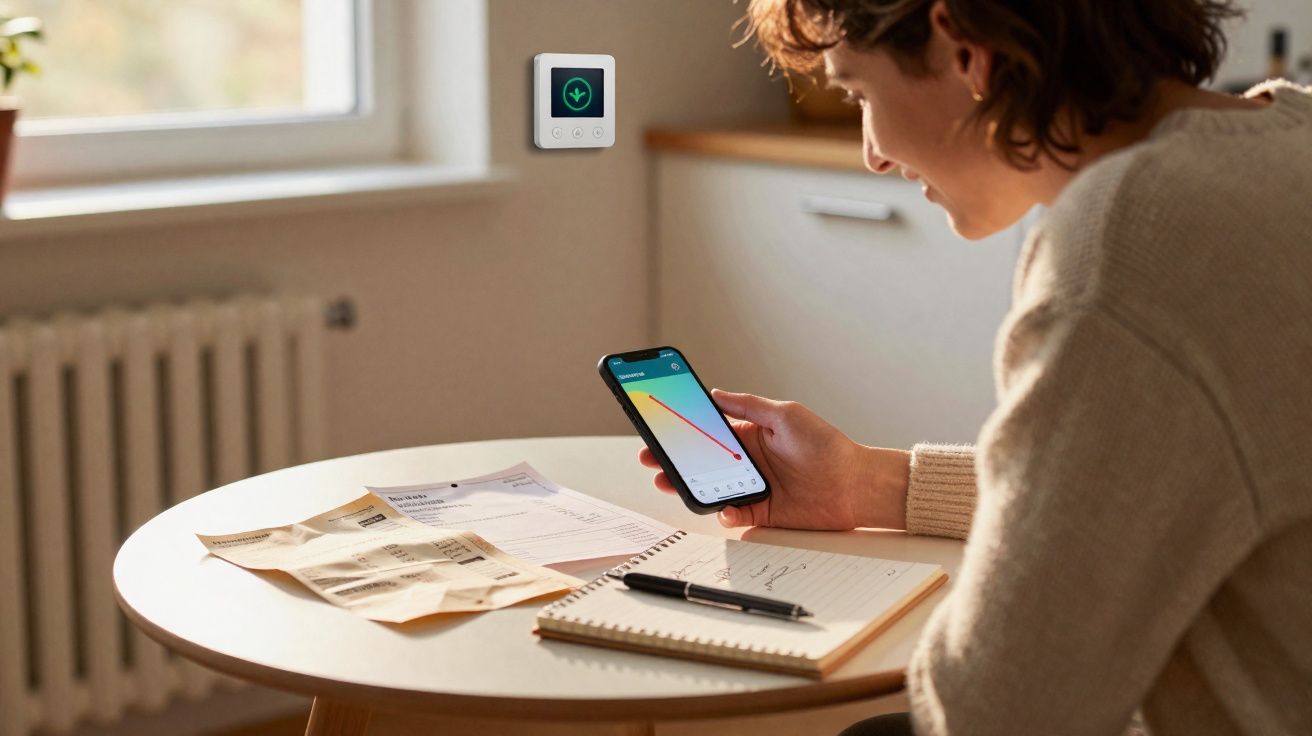
The kettle started its timid whistle as I pored over the latest bill, and the radiator made that faint metallic ticking it always does before it properly warms through. A three-year-old programmable thermostat sat on the wall like décor: I’d programmed it once, then more or less forgot it existed. The heating stayed on for hours after we’d left, yet the house felt cold at exactly the times we wanted it cosy.
That morning I bought a smart thermostat not because I love gadgets, but because my breath was misting in the kitchen while the money seemed to drift straight into the loft. I assumed it would be a minor convenience. I didn’t expect it to change how the house felt-or to show a payback as quickly as it did. The surprise arrived quickly.
The quiet leak in your heating routine
If you sketched your heating on a line chart, most UK homes don’t run on engineering- they run on habit. A blast from about 06:30 to 09:00, then another stint in the evening that slides towards bedtime because nobody wants to fiddle with buttons while brushing their teeth. We rush out at 08:10 and the boiler keeps quietly humming long after the last coat has gone. Other days we get home late and the radiators have been warming empty cushions for hours.
That isn’t deliberate waste; it’s just life: delayed trains, children’s clubs overrunning, a “quick one” that turns into two. And we’ve all had that sinking moment halfway to work when you realise the heating is still on. You picture the living room glowing like a greenhouse, the cat stretched out like royalty, and your gas meter spinning away.
Over a winter, those little misses add up to a steady leak. Not a burst pipe-just a drip you barely notice until the bill shows you the puddle.
Most homes don’t need more heat; they need smarter timing. That, in one line, is the point. A smart thermostat is there to close the tap on that drip without requiring monk-like routines. It observes, learns, and quietly trims the waste you never get round to trimming yourself.
How a smart thermostat learns your life and saves energy you never notice
A modern smart thermostat does the everyday jobs that an old wall box simply can’t do well:
- It adapts start times: earlier on frosty mornings, later on mild ones, because it learns how quickly your house actually warms up.
- It responds to occupancy: turning down when you’ve gone out, rather than when the schedule guessed you might.
- It runs the system more smoothly: nudging the boiler away from the wasteful on–off seesaw that causes overshoot and then cool-down.
On the first day in my house, it suggested dropping the setpoint from 20°C to 19°C and asked whether I was happy with that. One degree sounds trivial, but it can shave a meaningful chunk off gas use-without anyone feeling the difference. The only “complaint” came from the cat, who moved about 2.5 cm closer to the radiator.
Then geofencing kicked in. Leave the street and the heating eases back; turn into it again and the boiler wakes. It stopped the house behaving like a sauna when nobody was home and started behaving like it could count footsteps.
Six-month payback maths (not brochure promises) for a UK smart thermostat
The UK heating year is lopsided. In a typical home with gas central heating, most space-heating spend is concentrated across roughly October to March, not spread neatly across twelve months. If last winter’s gas spend for space heating came to around £700–£1,000, a smart thermostat cutting 15–25% of that waste would save roughly £105–£250 across the same cold stretch. With many units commonly discounted to £99–£149, the direction of travel is obvious.
Here’s what it looked like for me, based on smart meter readings and the thermostat’s own runtime logs:
- Average weekday runtime dropped from 6.5 hours to 5.1 hours.
- The morning peak pulled back by 35 minutes, because the hallway warmed faster than I’d assumed.
- The evening session shifted later by 20 minutes, so we weren’t burning gas at 17:00 for a 18:30 arrival.
- Across 90 winter days, the meter showed about 1,300 kWh less gas than the same period the previous year.
At roughly the unit rates many of us have been paying, that’s a solid three-figure saving before the clocks go forward.
Friends in a mid-terrace two streets away saw a similar pattern, but their biggest win came from occupancy detection. Their workdays are chaotic, and the heating used to run for plans that never happened. With phones acting like key fobs, the boiler slept when the house was empty and softened the heating as they approached. They saved about £35–£40 per month through the core winter months, and they’d picked up their thermostat in a Black Friday deal for £129. That isn’t hype. That’s payback before the daffodils are properly out.
The small behaviours you no longer have to remember
People often assume cutting energy means becoming a constant fiddler: tweaking radiator valves every time you leave a room, rewriting schedules when a meeting moves, opening a window for a quick blast of fresh air and remembering to turn the heating off first. In reality, almost nobody does that reliably. Life is too untidy for that level of choreography, and any plan that asks you to behave like a robot collapses by week two.
A smart thermostat takes all those good intentions and turns them into default behaviour.
- Window detection reduces heat when a door is left ajar and January air slips in.
- Weather lookahead / weather adjustment tempers the system so it doesn’t sprint when a jog would do.
- If the house has already warmed nicely by 08:15, it stops chasing a number just because the schedule says so.
That is saving in millimetres, not miles-but those millimetres add up across a UK winter.
There’s also something oddly human about “forgiving” technology. Forget to turn the heating down and it quietly corrects it. Come home early and it nudges comfort back without you needing to do anything. Those small kindnesses stop waste becoming a lifestyle choice and make efficiency the default.
Six months is a winter, not a lifetime
When people hear the word “payback”, they often think in years-more like solar panels. Heating doesn’t work like that. The spending is heavily concentrated in the colder months, which means the savings are concentrated there too.
Six months is exactly how long most UK homes ask the boiler to work its hardest. During those weeks, a smart thermostat is making decisions on your behalf constantly-small, dull, relentless ones. That’s where the money sits: not in one clever trick, but in hundreds of tiny corrections.
Quick sums you can do on the back of an envelope
- Find last winter’s gas spend for the months the heating was actually on (or use the smart meter app you keep meaning to check).
- Take a conservative 15% off that total if you previously ran a set-and-forget schedule.
- Compare that figure with the price of a decent smart thermostat when it’s on offer (which is how many people buy them).
If your thermostat costs less than your winter waste, the maths has already been done. Some homes beat 15% easily-especially where heating routinely ran for hours with nobody at home. Others land nearer that conservative figure and still see savings within the same heating season.
Where smart thermostats pay back even faster (and what to add next)
Households with irregular routines tend to gain the most: shift work, teenagers who treat doors as optional, families juggling clubs, shared custody, pet sitters coming and going. These are the homes where heat is lost by accident. A smart thermostat doesn’t prevent the chaos; it prevents the chaos from bleeding energy.
If you want to push further later on, smart radiator valves can tackle the classic problem: heating rooms you rarely use. That takes you into multi-zone control and can stack extra savings, but the basic payback story doesn’t depend on it. Even without valves, a smart thermostat controlling start times, setback temperatures and occupancy can remove a substantial chunk of fluff from the bill. Think of valves as the encore, not the main act.
There’s also efficiency in how the boiler is driven. By avoiding wild overshoot and long, wasteful cycles, many systems run more steadily. You experience that as comfort: less roasting followed by chills, more even warmth-and often less gas burned to get there.
A day with a smart thermostat feels different
Picture a late-January morning: that dry, metallic cold that nips at your ears as you step outside. The door clicks shut, your phone gives a small buzz, and the heating eases off behind you. The house doesn’t “sulk”; it rests. You walk to the station with a coffee warming your hands, and you don’t do the mental arithmetic of the bill because the boiler isn’t performing for an empty room.
On the way home, the system wakes as you reach your street. The hallway feels warm when you hang up a damp scarf. The radiator ticks gently-the sound it makes when it’s working rather than thrashing. The best saving is the one you don’t notice until the bill arrives. A good smart thermostat gives that kind of saving: less guilt, more ease.
Two things worth considering alongside your smart thermostat
A smart thermostat can only manage the heat your home can hold. If the loft insulation is thin, draughts whistle through letterboxes, or the house loses heat quickly through older glazing, you’ll still benefit from better control-but you’ll benefit more if you reduce heat loss at the same time. Even simple draught-proofing and topping up loft insulation can make the thermostat’s smarter timing go further.
It’s also worth thinking about privacy and usability. Features like geofencing rely on location services, and occupancy detection may use phone presence or sensors. Choose an app with clear settings, sensible permissions, and data you can actually understand-especially daily runtime views and temperature history-so you can see whether changes are delivering comfort as well as savings.
Before you tap “buy”
Compatibility checks are dull (and unavoidable), but they really do take about five minutes. Most UK combi boilers and system boilers work well with major smart thermostat brands, and some energy suppliers offer discounts that make the payback even clearer. Look for:
- Geofencing
- Weather adjustment / weather lookahead
- A clear app that shows daily runtime and heating history
If wiring makes you uneasy, most brands offer professional installation that’s usually finished in under an hour with minimal disruption.
Once it’s on the wall, give it one simple mission: cut waste without sacrificing comfort. Start at 19°C and let it learn how your home behaves. Trim your heating windows by 20–30 minutes and see whether anyone notices. Usually they don’t-apart from the meter.
Your home should feel warm at the right moments and disappear into the background the rest of the time.
There’s a quiet satisfaction in watching the usage graph over the first few weeks and seeing the evening block shrink like the tide going out. It isn’t smugness; it’s relief. You’re paying for warmth you actually feel, not for heating the empty gaps in a busy life. That’s why the six-month claim isn’t fantasy. It’s simply what winter looks like when the house is paying attention.
Smart thermostats don’t change your winter; they change the waste inside it. The cost of entry is often the same as a couple of decent dinners out-sometimes less with seasonal discounts-and the return shows up in the very season you buy. Once you see that, the decision stops feeling like a gamble and starts feeling like giving your home the brain it should have had all along.


Comments
No comments yet. Be the first to comment!
Leave a Comment