
Something almost imperceptible has shifted in the wash.
Across many homes the pattern is familiar: shirts stop looking freshly pressed, bed linen loses its sparkle, and socks that were once bright start drifting towards a dull beige. Small changes in washing temperature, product choice and day-to-day habits all contribute.
Why white laundry quietly turns grey or yellow
Very few white textiles remain genuinely white for long. With each cycle, minute residues of detergent, hard-water minerals and microscopic soil can remain behind. As those deposits accumulate, they lodge within the fibres and gradually mute the fabric’s appearance.
Natural body oils, perspiration and deodorant traces are another common cause. These substances cling to both cotton and synthetics, then oxidise over time, producing a creamy or yellow cast that often shows up first at collars, underarms and cuffs.
A modern twist is the move to cooler laundering. In an effort to cut energy use and treat fabrics more gently, many households default to 30 or 40°C. While that’s efficient, it doesn’t always break down heavier residues or reduce bacteria as effectively-particularly in towels and bedding.
Whites rarely look “old” because the fabric has aged; more often they look tired because invisible layers build up that standard low‑temperature cycles don’t fully shift.
Many detergents also contain fluorescent optical brighteners. These can disguise dullness for a time by reflecting light and making items appear whiter. Once those brighteners rinse away or wear off, the underlying greyness becomes noticeably apparent.
The one-scoop product bringing white back: sodium percarbonate (oxygen bleach)
An increasing number of European households-and now plenty of UK and US laundry enthusiasts-are turning to a straightforward ingredient: sodium percarbonate. You’ll often see it sold as oxygen bleach, active oxygen stain remover or laundry booster granules.
Unlike chlorine bleach, sodium percarbonate releases what chemists describe as active oxygen when it dissolves in hot water. That active oxygen reacts with coloured stains and organic residues, breaking them down into smaller fragments that can rinse away more easily.
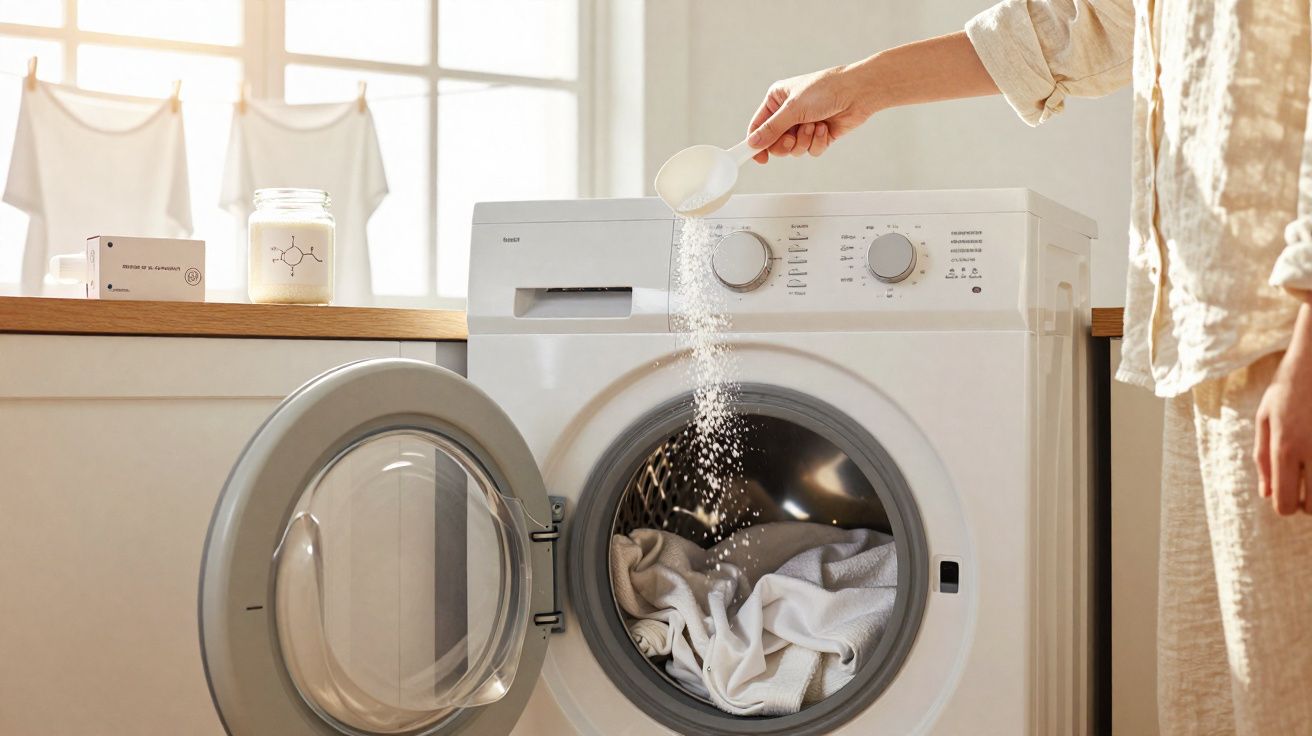
Add one level scoop of sodium percarbonate to a hot wash and it can lift the dull film that makes whites look grey, nudging fabrics closer to their original shade.
How to use sodium percarbonate safely and effectively
- Put one measuring scoop (typically 15–25 g-follow your pack guidance) into the drum or the detergent drawer.
- Select a programme of at least 60°C for towels, bed linen and robust white cotton.
- Use it alongside a standard powdered detergent to maximise both cleaning and whitening.
- Don’t use it on wool, silk or delicate elastics unless the care label specifically permits oxygen bleach.
Above 60°C, the whitening reaction accelerates, which is why it performs so well in “boil wash” style cycles used for hotel-like linen results. In cooler programmes the effect is gentler, but it may still help with mild staining and lingering odours.
Because sodium percarbonate breaks down into water, oxygen and soda ash, it often appeals to people trying to reduce chlorine-based products at home. Used at normal doses, it’s generally kind to fibres and can also help keep the washing machine drum and pipework cleaner.
Extra practical note (storage and mixing): keep sodium percarbonate sealed and dry, as moisture reduces its effectiveness. Avoid combining it directly with acidic products (such as vinegar) in the same step, and never mix it with chlorine bleach.
Sodium percarbonate vs baking soda vs baking powder
Cleaning “hacks” have blurred the line between the laundry cupboard and the baking shelf, but these white powders don’t behave in the same way. Sodium percarbonate, baking soda and baking powder each serve different purposes.
| Product | Main action in laundry | Best use case |
|---|---|---|
| Sodium percarbonate | Releases active oxygen to tackle stains and greying | Deep whitening at 60°C+ for towels, sheets and cotton |
| Baking soda (sodium bicarbonate) | Mildly alkaline; helps neutralise odours and slightly softens water | Freshening lightly soiled items, especially in cooler washes |
| Baking powder | Weaker mix: baking soda plus acidic agents and starch | A last-resort, mild cleaner when nothing else is to hand |
Where baking soda still earns a place
Baking soda doesn’t provide oxygen action like sodium percarbonate, but it can still be useful as a helper. In hard-water regions it can soften the water a little, allowing your detergent to work more efficiently.
It’s also handy for odour control-think gym kit or towels that have gone musty after being left damp. Adding a couple of tablespoons alongside your usual detergent dose can reduce smells without relying on heavy perfume.
Baking powder, by contrast, isn’t formulated for washing machines. Although its sodium bicarbonate content may offer a small cleaning boost, the additional acidic agents and starch make it a comparatively weak option, best kept as an occasional stopgap rather than a routine solution.
The right washing programme for whiter laundry
Even the best additive can’t compensate for the wrong cycle. For white cottons and mixed household linen, many appliance engineers and textile specialists favour a standard 60°C cotton programme.
These cycles are typically long enough to dissolve detergent properly, maintain a steady temperature and give oxygen-based boosters time to work. A faster spin-around 1,200–1,400 rpm-then extracts more soiled water before drying, which helps prevent re-depositing grime.
A consistent 60°C cotton cycle, paired with a reliable detergent and a scoop of oxygen bleach, often keeps whites brighter than quick eco programmes.
Cooler, shorter cycles designed for delicates and synthetics can leave incremental residue over time. Where care labels allow, putting towels and white bed linen through a full 60°C wash every few cycles can act as a “reset” for brightness.
Balancing hygiene, fabric care and energy bills
Most households are trying to balance three competing priorities: proper hygiene, longer-lasting textiles and manageable energy costs. Health guidance commonly still supports 60°C washing for certain categories, including:
- Bed linen used during illness or by allergy sufferers.
- Bathroom towels and kitchen cloths.
- Underwear and reusable nappies (only if the care label permits).
Washing everything hot, however, can shorten the life of elastics, prints and delicate blends, while also increasing electricity use. A sensible middle ground is to keep fashion items on cooler cycles, reserving the 60°C white wash for core household pieces-and for “recovery” washes when greying becomes noticeable.
Practical strategies to keep whites bright for longer
Beyond a one-scoop booster, routine habits make a visible difference. Sorting is still crucial: washing whites with coloured items invites gradual dye transfer, which settles onto lighter fibres and dulls them over time.
Detergent dosing matters too. Too much can leave a tacky film that traps grime; too little can leave soils behind, which then set during drying. Following the dosing guidance for your water hardness and load size may feel fussy, but it’s often the quickest route to better-looking whites.
Hard water can add another layer of dullness. Limescale inside the machine can hold on to grey sludge that later reattaches to fabric. An occasional empty maintenance wash at 60 or 90°C with an oxygen-based product can help flush out build-up.
Another helpful addition (drying choices): when the care label allows, drying white cottons in daylight can support brightness over time. Conversely, overdrying on high heat can bake in residues and set stains, so aim for the lowest effective tumble setting or remove items while slightly damp.
Spot-treating and rescuing “ruined” whites
Some marks respond best before the main wash. Sweat staining, fake tan and food spills can bind tightly to fibres and may not lift with repeated standard cycles alone. For washable white cotton, you can make a paste using a small amount of sodium percarbonate and warm water, apply it carefully to the stain, then wash as normal. Always test first on an inside seam.
If a favourite shirt has gone uniformly grey, repeated 60°C washes with oxygen bleach can gradually improve it. Outcomes depend on fibre type, garment age and existing wear, so it’s wise to keep expectations realistic: thinning fabric, abrasion and long-term deodorant build-up are not always reversible.
Environmental and health angles behind the whitening trend
As more people move away from bleach-heavy routines, oxygen-based products have found a middle position between aggressive chemistry and purely “natural” approaches. They still rely on chemical reactions, but they avoid chlorine and typically break down more cleanly in wastewater systems.
Dermatologists also report that some people experience fewer irritation problems when they use fragrance-free detergents with oxygen boosters, compared with highly perfumed detergents and fabric softeners. Fragrance compounds and certain preservatives can sit on fabric surfaces and may trigger reactions-especially in areas that remain warm and damp against the skin.
For households managing allergies, eczema or asthma, a fragrance-free main detergent, a measured scoop of sodium percarbonate on whites and thorough rinsing can help reduce both lingering odours and overall chemical load.
What this shift means for your laundry routine
The renewed popularity of oxygen-based whiteners points to a broader change in how households treat everyday textiles. Instead of replacing dull towels or bedding every year, many people are trying to restore what they already own through better cycles and targeted chemistry.
Done consistently, this can extend fabric life, modestly reduce textile waste and mirror what commercial laundries have long relied on: controlled temperatures, accurate dosing and specialist boosters for specific needs.
If you’re staring at a basket of greyish “once-white” laundry, a simple trial-one scoop of sodium percarbonate used with the right programme-can be a low-effort way to test the difference. The results are rarely theatrical, but a genuinely brighter load often arrives sooner than expected, and it tends to reshape how the next wash day is planned.



Comments
No comments yet. Be the first to comment!
Leave a Comment