
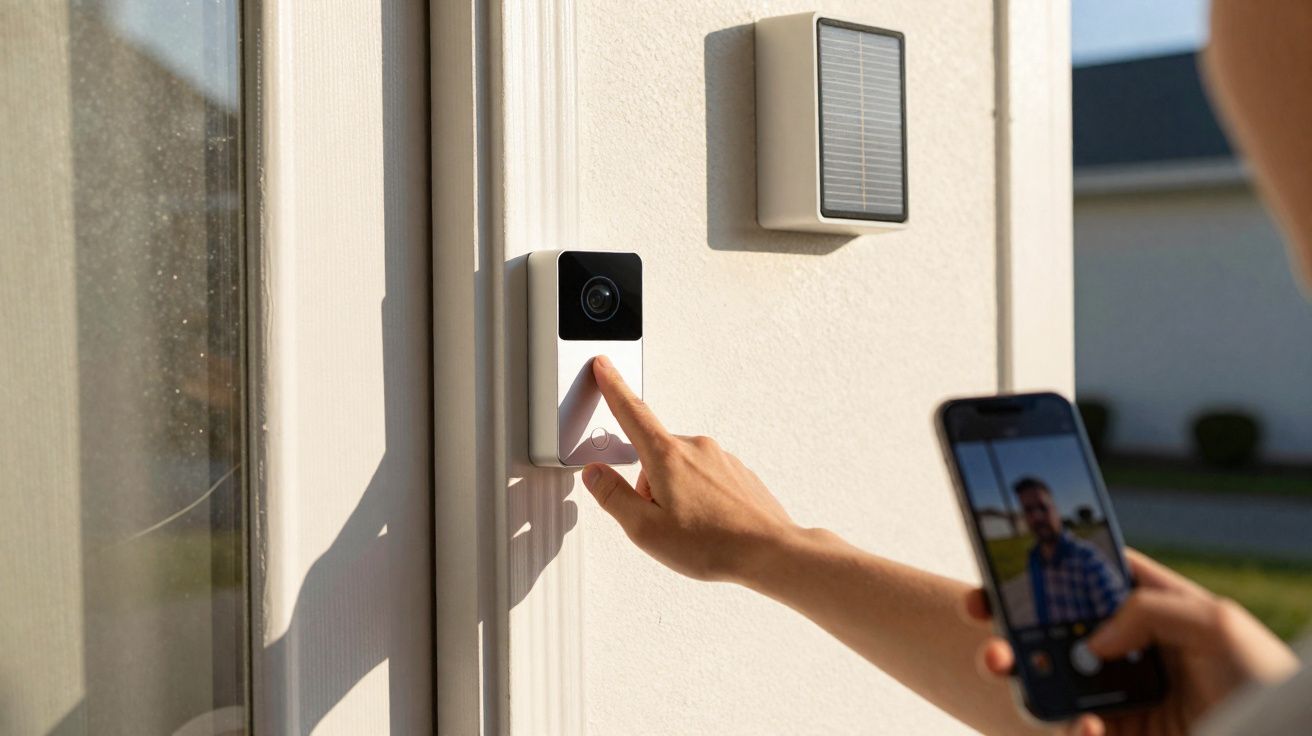
Ring, Amazon's smart home brand, is pushing the image quality of its video doorbells up a notch. For the first time, there are cordless 4K models, along with new 2K devices, a PoE flagship aimed at professional installations and accessories such as solar chargers and a Chime. In effect, Ring is now targeting almost every budget and every type of home, from a compact terraced house to a fully connected villa.
4K at the front door: what Ring now offers
The centrepiece of the new range is the second-generation Ring Battery Video Doorbell Pro. It is a cordless video doorbell with 4K resolution, which means four times the detail of Full HD. In practical terms, that gives you sharper faces, more information in the frame and, provided the angle is right, better readability for parcel labels and number plates.
According to Ring, the Pro model comes with several technical upgrades:
- 4K video with significantly greater detail
- digital zoom of up to 10x
- redesigned sensors for improved night vision
- a new internal architecture for better performance
- a fast-charging battery so the doorbell does not need to live on a charger all the time
The thinking behind the 4K push is simple: visitors, delivery drivers or suspicious individuals should remain clearly identifiable even in poor light and from a greater distance.
This matters most on driveways, at blocks of flats or in homes with deep front gardens, where resolution can make the difference between a usable image and one that is too vague to help later on. Here, Ring wants to clearly outperform its existing Full HD and 1536p models.
A further advantage is how well these cameras can fit into a broader smart home setup. Linked with the right app routines, the doorbell can trigger lights, send alerts to more than one phone and help household members react faster when someone arrives unexpectedly.
Ring's 4K video doorbells: PoE Elite model for professional installations
Alongside the battery-powered Pro, Ring is introducing a new Wired Video Doorbell Elite. It also records in 4K, but it does away with both batteries and Wi‑Fi. Instead, it relies on Power over Ethernet (PoE). A single network cable supplies both power and data.
That clearly targets people with more demanding requirements:
- extremely stable network connectivity, with no Wi‑Fi dropouts
- constant power, so there is no need to worry about charging cycles
- suitable for new builds or renovations with existing network infrastructure
- more headroom for functions such as motion detection and remote access
The Elite version sits at the premium end of the market and is designed primarily for smart new builds, larger properties or small commercial premises. Setup is more involved because a PoE cable has to be installed, but in return the system should run for years with very little maintenance.
For anyone planning a refurbishment, it is worth thinking about cable routes, router placement and where the doorbell will sit before the walls are finished. That extra planning can make the difference between a tidy professional installation and a system that is awkward to maintain later.
Solar charger and Chime: accessories that make the system more practical
For the cordless models, Ring is also bringing out a new solar module. It mounts directly behind the video doorbell and continuously tops up the battery whenever there is enough daylight.
In practice, the solar panel can noticeably cut the number of charging sessions, especially on façades that get plenty of sun.
The important caveat is that a solar module will not do much in dark entrances or under deep canopies. Anyone who wants to make proper use of the technology should aim for a fairly unobstructed south-facing position.
Inside the house, the new Chime Plus makes sure doorbell alerts do not only appear on a smartphone. The compact speaker plugs into a wall socket and announces the ring loudly and clearly, which is useful if the phone is in another room or if family members do not have app access.
Prices of the key new devices
| Product | Type | Resolution | Manufacturer’s price |
|---|---|---|---|
| Battery Video Doorbell Pro (2nd gen) | cordless | 4K | about £215 |
| Wired Video Doorbell Elite (new) | PoE, wired | 4K | about £430 |
| Solar charger | accessory | – | about £43 |
| Chime Plus (2nd gen) | indoor chime | – | about £52 |
Three new 2K models: same platform, fewer pixels
Alongside the 4K flagships, Ring is adding three video doorbells with 2K resolution. They are intended to offer a more affordable entry point, but they are built on the same underlying platform.
The line-up includes:
- Battery Video Doorbell Plus (2nd gen) – cordless, 2K, improved battery, priced at around £155
- Battery Video Doorbell (2nd gen) – a simpler cordless 2K doorbell with up to 6x zoom, priced at just under £86
- Video Doorbell Wired (2nd gen) – 2K, wired for existing doorbell wiring, priced at around £69
That means Ring now covers a range from an entry-level model under £100 to a £430 Elite doorbell, all with app connectivity and cloud services.
The 2K devices are aimed mainly at users who want a clear picture but do not necessarily need 4K, for example in narrow hallways or directly at a flat entrance in a block of flats, where viewing distances are short.
When does 4K at the front door really help?
4K sounds attractive, but the real benefit depends heavily on installation. Anyone who wants to make proper use of 4K should keep a few things in mind:
- Distance to the door: the further visitors stand from the camera, the more the extra resolution pays off.
- Lighting: strong outdoor lighting plus improved night vision leads to sharper footage at dusk and in the dark.
- Network connection: 4K video streams need solid Wi‑Fi or PoE connections. Older routers or weak repeaters can slow things down.
- Storage and data usage: higher resolution creates more data, which has to be stored in the cloud or locally.
Many homes still begin their smart doorbell journey with Full HD. 4K is likely to appeal to people who already have experience and now want better detail recognition, whether that is for recurring late-night visitors, vandalism or valuable parcel deliveries.
Privacy, subscriptions and legal pitfalls
Anyone fitting a connected doorbell quickly runs into the tension between security and data protection. In Germany, the rule is clear: the camera must not continuously record public pavements or a neighbour’s property. The field of view should ideally be limited to your own property and the immediate entrance area.
As usual, Ring leans heavily on its cloud service. Without a paid subscription, many convenience features are limited, including longer-term recording storage and more advanced notifications. If you want maximum control, it is worth checking in advance which functions are available without a subscription and whether the added sense of security justifies the ongoing cost.
It is also sensible to test motion zones and privacy settings before relying on the system day to day. That helps you focus on the areas that matter and avoid capturing more of the street than you actually need.
Practical uses in everyday life
In reality, a 4K doorbell can do much more than simply show that someone is standing at the front door. Here are a few typical examples from everyday use:
- Delivery drivers leave parcels in a defined spot, and the camera records the condition on arrival.
- Working parents can check on their phones when children arrive home from school.
- Holiday home owners can keep an eye on the entrance without being on site all the time.
- Older people can verify who is outside before opening the door.
Particularly in bad weather, during the darker months or when there are repeated disturbances in a shared hallway, a detailed recording makes it easier to reconstruct what happened later, whether that is for the letting agent or in the event of a dispute.
Where the investment is most worthwhile
Households with lots of deliveries, freely accessible entrances or set-back front doors, where visitors do not stand directly in front of the camera, stand to benefit most. In those situations, 4K, strong zoom and improved night vision can really show their strengths.
By contrast, if you live in a small town flat, have the building entrance directly by your door and only receive the occasional parcel, a good 2K model is often enough. In both cases, battery versions and solar chargers make installation much easier because there is no need for an electrician to run a doorbell cable.
It will be interesting to see how quickly other manufacturers respond. One thing is already clear: video doorbells are moving from novelty status to a standard part of the smart home, and with this latest generation Ring is bringing the technology noticeably closer to traditional security cameras.





Comments
No comments yet. Be the first to comment!
Leave a Comment