
It begins with a chill you didn’t see coming.
You’re sat in the living room; the radiator is quietly ticking away beneath the window, yet every time you pass the same stretch of wall your back feels cold. The meter seems to be racing, your latest energy-bill email has landed with a thud, and your feed is full of the same “genius” advice: put aluminium foil behind radiators and watch your heating costs fall.
You scroll past photos of gleaming, silver-backed walls and triumphant DIYers. Some claim they’ve saved 20%. Others insist it’s complete rubbish. Your hand hovers over the roll of foil in the kitchen drawer.
So is aluminium foil behind radiators a clever hack energy companies don’t want you to know about… or just another internet fairy tale?
Does aluminium foil behind radiators really do anything?
Step into an older flat in winter and you notice it immediately: the radiator is hot, but the wall behind it feels icy-sometimes almost clammy with cold. In many homes, a meaningful slice of the heat you’ve paid for is absorbed by that cold masonry and then lost to the outdoors. That real-world problem is where the aluminium foil story started-somewhere between genuine building physics and social-media exaggeration.
The promise is appealingly straightforward: radiator → cold wall → shiny surface → more heat reflected back into the room. You don’t need an engineering degree to want it to be true.
And this isn’t new. In the UK (and across parts of Northern Europe), reflective radiator solutions have been discussed for decades-long before reels and viral threads. Some older council properties even had proper reflective panels installed behind radiators, rather than a strip of kitchen foil. The UK’s Energy Saving Trust has previously highlighted that purpose-made reflective panels can reduce heat loss through a wall by a noticeable amount, particularly where the radiator is on an uninsulated external wall.
You’ll still see forum posts along the lines of: “We put foil behind the bedroom radiator years ago and the wall stopped feeling freezing.” It isn’t a controlled trial, but it’s the kind of lived experience that keeps the idea circulating.
The underlying science isn’t mysterious. A radiator warms a room through a combination of:
- Convection (circulating warm air)
- Radiation (infrared heat “beaming” from the hot surface)
If you place a reflective layer behind the radiator, some of that radiated heat can be redirected back into the room rather than being absorbed by a cold wall. The catch is that kitchen foil is thin, easily creased, and rarely installed smoothly or securely, which limits how well it performs in practice.
So yes-there’s a real principle here. The practical question is how much difference you’ll actually get, and whether a taped-on DIY sheet of food-grade foil can come anywhere near the results seen with flatter, more robust insulating reflector panels.
When it’s worth trying (and when it isn’t)
This idea makes the most sense when all of the following are true:
- The radiator sits on an external wall
- The property is older or poorly insulated
- The wall behind the radiator becomes very cold in winter
If the radiator is mounted on an internal partition wall, or your flat already has insulated external walls, you’re much less likely to notice any change-because there’s far less heat escaping into the building fabric in the first place.
A sensible extra step (if you like to see evidence) is to check the wall temperature behind and around the radiator with an inexpensive infrared thermometer before and after. You won’t get laboratory precision, but it can help you judge whether your specific set-up is a good candidate.
How to do it “right” if you still want to try aluminium foil behind radiators
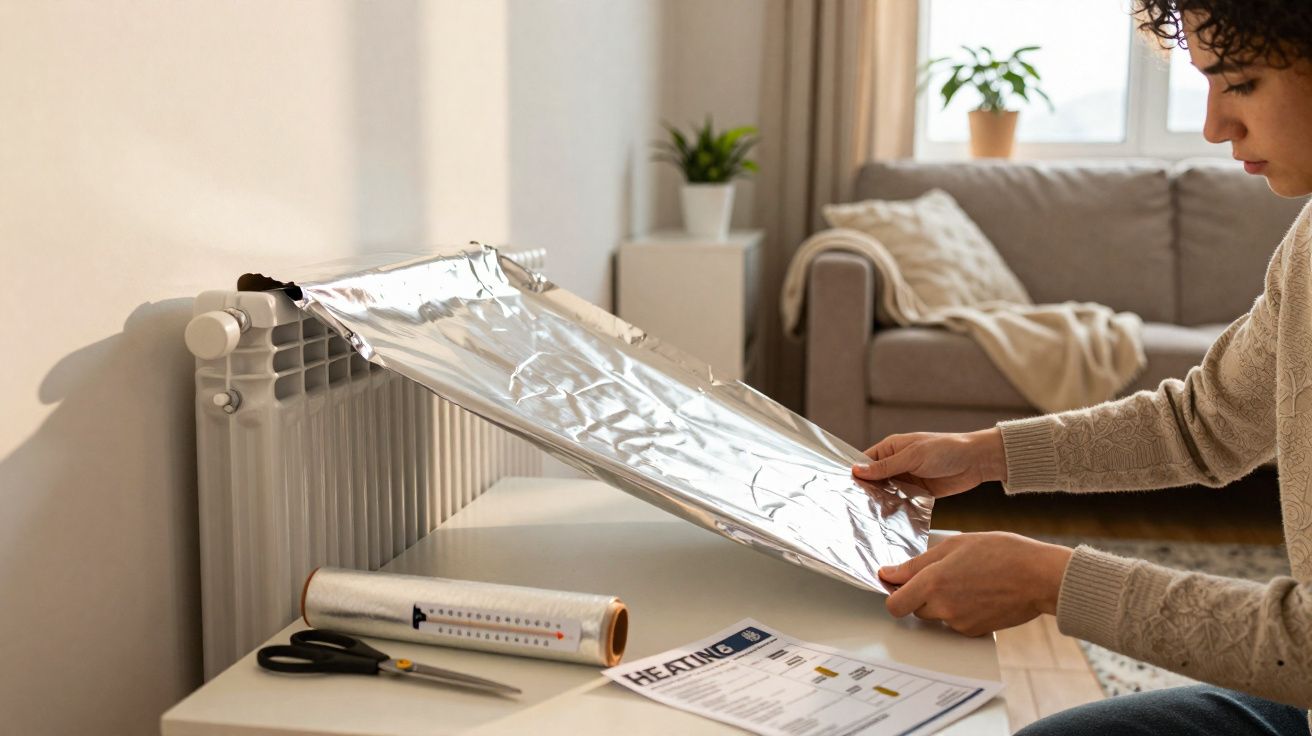
If you want to test the trick, approach it like a curious adult-not like a rushed social-media challenge. Ideally, do it on a radiator mounted to a cold external wall in a home where insulation is lacking. If you can, gently pull the radiator forward; if that’s not practical, you may have to work from above using a long, firm board to guide a panel into place.
Cut a piece of aluminium foil slightly larger than the radiator. For better results, fix the foil to a backing (thin cardboard or foam board) so it stays smooth. The shiny side should face the room, not the wall.
Many people simply tape foil straight onto the wall and hope for the best. In reality, it often peels away, curls up, or drops off-especially if the wall gets damp. That’s when a “cheap hack” becomes visual clutter behind the radiator.
A more reliable approach is to make a lightweight panel that slides behind the radiator and is held in place with small adhesive pads or hooks. Leave a small gap so air can move; you don’t want to block airflow around the radiator.
What matters most isn’t the shiny foil itself, but whether you’re reducing heat loss into a cold wall that’s effectively drinking your energy bill.
Practical checklist:
- Choose the right spot: Use foil only behind radiators on external, poorly insulated walls.
- Use a backing: Cardboard or foam board keeps the foil smooth and properly reflective.
- Keep it safe: Keep foil away from electrical sockets, loose cables, or built-up dust that could pose a risk.
- Combine with the basics: Bleed your radiators, stop draughts, and improve window insulation before expecting miracles.
- Watch for moisture: If the wall is damp or prone to mould, prioritise proper insulation and ventilation rather than relying on foil-based fixes.
Cheap trick, partial fix, or total nonsense?
The most honest answer lives in a grey zone that rarely goes viral. On a cold external wall, behind an older hot-water radiator, a reflective panel-even a carefully made DIY one-can reduce heat loss a little. You may find the room feels slightly more comfortable, and in a tight-budget winter that comfort can matter as much as the exact numbers.
However, you will not halve your bill with a few strips of kitchen foil. Energy companies are not lying awake worrying about this trend.
If you want the same basic benefit with fewer drawbacks, purpose-made radiator reflector panels can be a better option: they tend to sit flatter, stay in place, and often combine reflection with a thin insulating layer. Foil alone is usually at its best as a small add-on-useful in the right location, but never the main solution.
| Key point | Detail | Value for the reader |
|---|---|---|
| Best use case | Old radiators on uninsulated external walls | Helps decide if the trick is worth trying at home |
| Realistic effect | Small comfort gain, modest energy savings | Sets expectations and avoids disappointment |
| Smarter priority | Seal draughts, insulate windows, bleed radiators | Focuses effort on changes with bigger impact |
FAQ: aluminium foil behind radiators
Question 1: Does aluminium foil behind radiators really save money?
On a cold external wall, you may reduce heat loss slightly and get a small comfort improvement. Savings are usually modest rather than dramatic, and they depend heavily on how well your home is insulated overall.
Question 2: Is it safe to put foil behind any type of heater?
It’s generally meant for traditional hot-water radiators fixed to masonry walls. Avoid using foil near electric heaters with exposed elements, fan heaters, or anything that runs extremely hot or has accessible wiring.
Question 3: Can I use regular kitchen foil, or do I need special panels?
You can use kitchen foil in a pinch-ideally mounted on cardboard or foam board. Purpose-made reflective radiator panels tend to work better because they combine reflection with insulation and remain secure more reliably.
Question 4: Will this trick help in a modern, well-insulated flat?
Probably not enough to notice. In newer buildings with insulated external walls and efficient radiators, you’ll usually get more value from tackling draughts and using a smart thermostat well.
Question 5: What should I do first if my heating bills are exploding?
Start with the big wins: seal draughts around windows and doors, close off unused rooms, bleed your radiators, reduce the thermostat by 1°C, and look into loft or wall insulation. Foil is a tiny bonus, not a miracle solution.
Comments
No comments yet. Be the first to comment!
Leave a Comment