
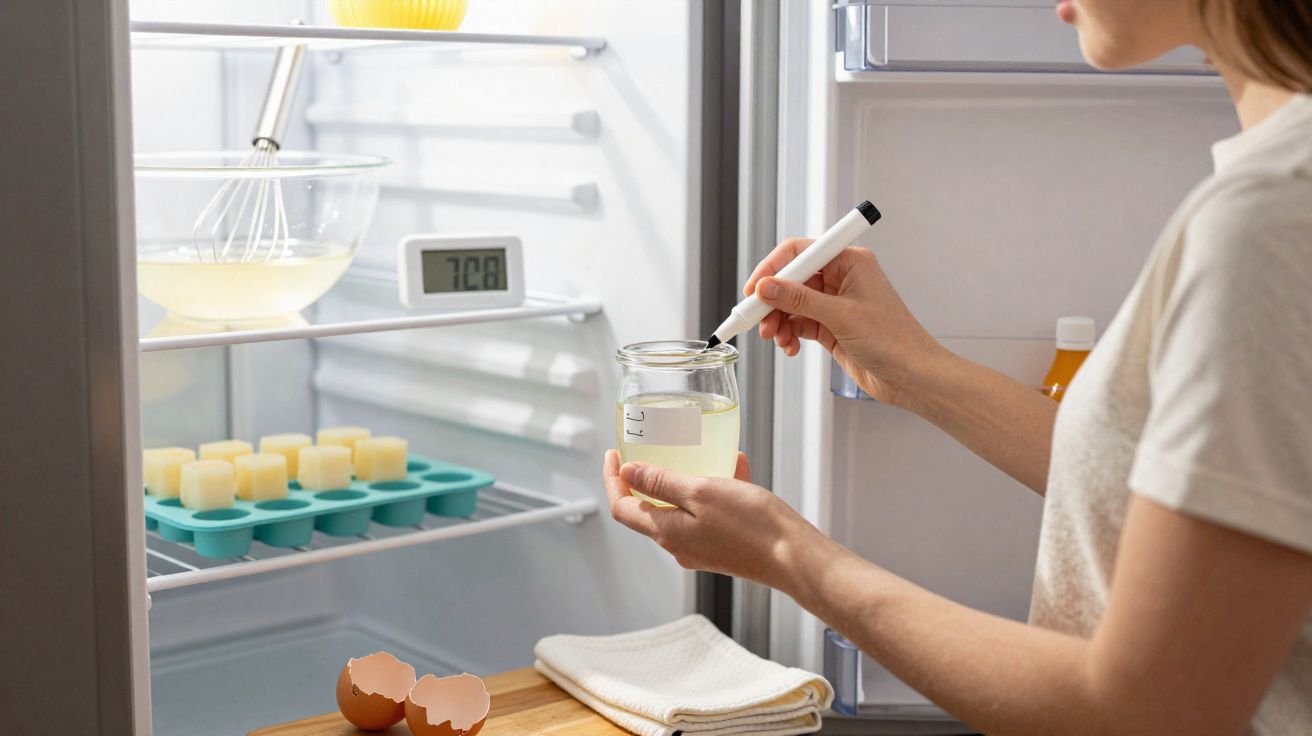
When baking or cooking, it is very easy to end up with a few spare egg whites. Only the yolks go into the carbonara, the custard for crème brûlée uses the yolks as well, and the whites are then left over and quickly put in the fridge. From there, the bowl often sits for longer than intended. Some people are happy to keep it for several days, while others throw it away after just 24 hours. So what is actually right if you want to avoid any risk?
Why egg white needs extra care
Raw eggs are among the most delicate foods in the kitchen. Germs can live on and in the shell, and they can easily transfer into the egg white when the egg is cracked open. Cold fridge temperatures do slow bacterial growth, but they do not stop it completely.
The crucial point is this: once the protective shell is gone, the egg white has no barrier left. It sits exposed in a container and reacts far more sensitively to temperature changes and poor hygiene than a whole egg does.
The longer raw egg white sits in the fridge, the greater the risk of germs becomes - even at 4°C.
That is why recommendations vary so much. Many kitchen professionals judge things by whether the egg white will later be cooked thoroughly. Food hygiene specialists take the most cautious view and focus on dishes that are not heated strongly afterwards.
How long egg white can stay in the fridge
A maximum of 24 hours for raw recipes
If the egg white is going into a dish that will not be heated at all, or only very lightly, there is a clear limit. Typical examples include:
- chocolate mousse that is not heated afterwards
- cold creams and desserts made with raw beaten egg white
- homemade protein shakes with fresh egg white
- mayonnaise made from raw eggs
In dishes like these, the egg white never reaches temperatures high enough to kill germs. Many harmful bacteria only die once the centre of a food is heated to at least 65°C for a sustained period.
For anything that is eaten raw or only gently warmed, egg white should have spent no more than one day in the fridge.
This matters especially if young children, older people, pregnant women or anyone with a weakened immune system is eating it. Choosing the safest option here greatly lowers the risk of stomach and intestinal infections.
If you regularly make uncooked desserts or dressings, pasteurised liquid egg white is the better choice. It has been heat-treated beforehand, so it is much more suitable when a recipe depends on raw egg white.
Three to four days for well-baked dishes
The situation is different when the egg white later gets proper heat in the oven. Typical recipes include:
- sponge cakes and simple butter cakes
- soufflés and bakes
- pavlova and other meringue cakes
- very dry meringues
During baking, the inside of the mixture reaches temperatures well above 100°C. Germs do not stand much chance there. Under clean conditions, many kitchens can use egg white for three to four days in the fridge, as long as it has been stored at a steady temperature of about 4°C.
There is also a side effect: egg white changes in structure the longer it is stored. Some bakers find that beaten egg white from older eggs is slightly harder to whip up or does not hold its shape quite as well. That is less about safety and more about getting the best texture.
The most important hygiene rules for stored egg white
Whether you keep it for one day or four, even the best rule of thumb is useless without clean working habits. If you want to store egg white, you should follow a few points strictly.
- Crack the eggs only when you are ready to use them, not in advance.
- Never use a bowl that has previously held raw meat.
- Use only very clean, dry containers that close as tightly as possible.
- Put the container straight into the coldest part of the fridge, usually on a shelf above the salad drawer or just above the meat compartment.
- Do not leave egg white at room temperature for longer than two hours.
- Label the container with the date so you can keep track of how long it has been stored.
If the egg white smells or looks even slightly odd, it goes in the bin - no debate.
A sweet, unfamiliar or sulphurous smell, cloudiness, or a slimy surface are all warning signs. At that point, how long it should theoretically last no longer matters.
If you need to keep it longer: freeze the egg white
If you know you will not need the egg white for a raw dish in the next 24 hours, and not for baking in the next few days either, the freezer is the better option.
How to freeze it successfully
A simple method has proved effective in practice:
- Pour the egg white into an ice cube tray - roughly one egg white per compartment.
- Freeze the tray until the cubes are completely solid.
- Transfer the frozen egg white cubes into a well-sealing tub or bag and mark it with the date.
This keeps egg white usable in the freezer for around four to six months. Be aware that beaten egg white will then take a little more patience and time to whip. For cakes, savoury bakes, or well-dried meringues, these frozen portions are ideal.
Smaller portions are especially practical because you can thaw only what you need. That reduces waste and stops you from repeatedly opening and closing one large container.
Important: frozen egg white is safest when defrosted in the fridge - ideally overnight. At room temperature, it quickly enters the temperature range where germs can start to feel comfortable again.
How to avoid storage mistakes
The biggest risks usually do not come from a single slip, but from several small lapses happening together. Common mistakes include:
- storing egg white in an uncovered bowl beside strongly smelling foods
- not wiping away splashes of egg white from the rim of the bowl
- leaving the fridge open for too long again and again
- relying on memory instead of writing the date down
If you keep these points in mind during everyday cooking, you can cut the risk massively without having to worry nervously about the use-by date every time. In family kitchens where several people share one fridge, clear labelling on the container also helps prevent mix-ups.
How to plan and use leftover egg white sensibly
Instead of wondering each time what to do with the leftovers, it is worth having a small plan. Plenty of recipes are perfect for turning spare egg white into something tasty. Classics include coconut macaroons, amaretti biscuits, meringue toppings for fruit cakes, or simple cakes in which some of the eggs are replaced with egg white.
If you bake regularly, it makes sense to collect recipes that are specifically designed for egg white leftovers. That way, less ends up in the bin, and you do not have to recalculate things every time. Frozen egg white is especially useful here, because it lets you bake several such recipes in one go at the weekend.
A good habit is to keep a small freezer box reserved for egg whites only. Once it is clearly labelled and dated, you can build up a useful stock for the next cake, dessert or batch of meringues without any guesswork.
Why gut instinct is not enough
Many people judge eggs and egg white by smell or by the best-before date on the pack. With egg white stored separately, that instinct only goes so far. Germs that can cause stomach and intestinal upset do not always change the appearance straight away. Sometimes the egg white still smells normal even though it has already been stored for too long.
That is why a little structure in the kitchen helps: write the date down, choose the storage place carefully, and check the fridge temperature from time to time. If you then remember the different time windows - up to one day for raw uses, up to four days for well-baked dishes, and several months in the freezer - you can handle leftover egg white much more safely and even save money in the process.





Comments
No comments yet. Be the first to comment!
Leave a Comment