
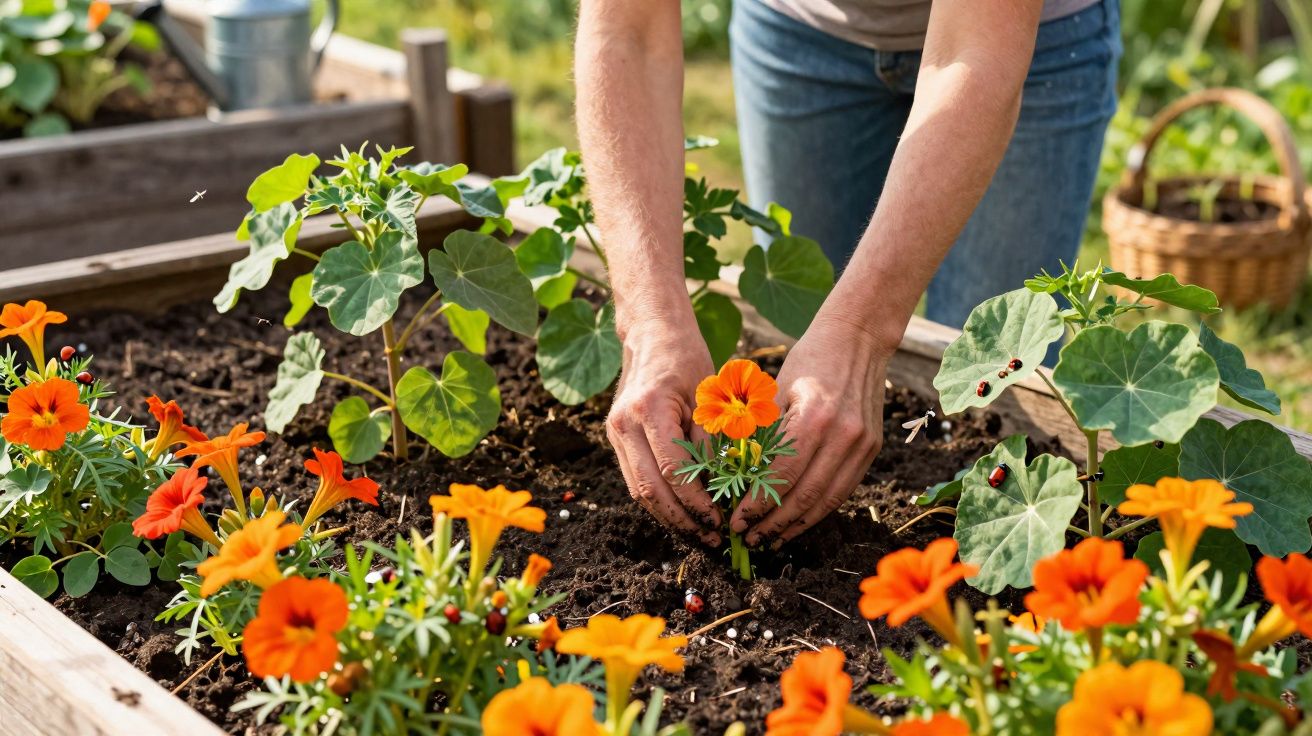
Across vegetable beds and flower borders, there’s a low-level battle underway: pests hunting their next meal, and a host of helpful garden creatures trying to keep them in check.
Rather than defaulting to pesticides, more gardeners are leaning on smart planting plans. With the right combinations, certain flowers and crops work like living shields-bringing in pollinators and predator insects, while discouraging the insects that chew leaves, pierce stems and burrow into roots.
Why your veg patch needs “bodyguard plants” for companion planting
Many modern plots are neat to the point of being unhelpful. A couple of tidy rows of lettuce and tomatoes may look orderly, but they don’t provide enough shelter, nectar or alternative prey for the insects that naturally control pests.
Add a few carefully chosen species among your vegetables and the balance shifts. You create nectar stops for pollinators, hunting territory for ladybirds and hoverflies, and “trap” areas that tempt pests away from the crops you most want to protect.
Picture these four plants as a mixed security team: some call in back-up, some act as decoys, and others quietly disrupt soil-borne parasites.
The four reliable options below-French marigold, nasturtium, broad bean and pot marigold (calendula)-slot into almost any setup, from a balcony container to a full-sized allotment.
French marigold: a bright edging with a hidden defence system
French marigold (Tagetes patula) flowers from early summer right into autumn, forming compact domes dotted with orange, yellow and red blooms. It may look purely ornamental, but it earns its place by supporting pest control on several fronts.
How French marigold protects your crops
- Pollinator magnet: Nectar-rich flowers pull in bees, bumblebees and butterflies.
- Smell-based shield: The strong scent can deter some small beetles and reduce aphid pressure nearby.
- Root-level action: Roots release compounds that interfere with certain root-knot nematodes-microscopic worms that distort roots and slow growth.
Because of these combined effects, French marigolds make strong companions for tomatoes, peppers, aubergines and beans. Tuck them between vegetable rows or plant them as a ring around raised beds.
Where nematodes are a recurring problem, growing French marigold for a season and rotating back to vegetables can cut damage without a single chemical treatment.
Start plants under cover in spring or buy plug plants early in the season. They cope with most soils provided drainage is decent and they get plenty of light.
Nasturtium: the sacrificial plant that saves your veg
Nasturtium (Tropaeolum majus) is an annual with long trailing stems, rounded leaves and vivid flowers in orange, red or yellow. It’s often grown for its looks (and its edible petals), but its real value is how readily it distracts pests from neighbouring crops.
Aphid magnet, by design
Aphids find nasturtium hard to resist. When given the option, they’ll frequently choose nasturtium over beans and other vegetables, clustering heavily on the sacrifice plant instead.
Set near brassicas, beans or fruit trees, nasturtium works as a trap crop-a deliberately expendable plant that gathers pests into one manageable place.
Instead of treating the entire plot, you can target one aphid-covered patch and keep the rest of the garden intervention-free.
The flowers and young leaves are edible, adding a peppery kick to salads. Sow indoors from March in cooler areas, then sow outside once the risk of frost has passed. Let some plants spill from pots or drape over bed edges to shade bare soil and help suppress weeds.
Broad bean: dinner for you, decoy for aphids
Broad bean (Vicia faba) is a generous crop, producing tall plants with pod-filled stems. It also doubles as a useful tool in integrated pest management.
How broad beans fit into a pest strategy
Like nasturtiums, broad beans commonly draw black bean aphids, especially towards the plant tops. That sounds alarming-until you realise the pattern is predictable and therefore controllable.
- Pinch out the infested shoot tips and remove most aphids in one go.
- If numbers spike, use a water spray with a small amount of soft soap.
- Keep the lower parts of the plants intact so pods can swell and ripen with minimal disturbance.
Sowing early matters. In milder parts of the UK you can begin in late winter; colder areas are better from early spring. Broad beans also improve soil by fixing nitrogen, which benefits following crops such as brassicas.
A single row of broad beans can serve as both supper and a decoy, drawing aphids away from more delicate salads and ornamentals.
Pot marigold (calendula): a nectar bar and an underground guardian
Pot marigold, or calendula (Calendula officinalis), is another cheerful annual, flowering from early summer until cold weather arrives. Its yellow and orange daisy-like blooms are not just decoration-they actively support the “good guys” in your patch.
Boosting beneficial insects with calendula
Calendula produces abundant nectar and pollen, feeding a wide range of allies including hoverflies, lacewings and predatory beetles. Their larvae then do the hard work, consuming large numbers of aphids.
Below ground, calendula can also influence nematodes. Certain strains produce scents and compounds that deter harmful types, while encouraging soil life that disrupts pest cycles.
Dot calendula through the veg patch and you effectively recruit a roaming patrol of larvae that comb stems and leaves for soft-bodied pests.
Sow under cover from late winter and plant out after frost, or direct sow in spring. Calendula readily self-seeds, so once it’s established, it often reappears each year with little effort.
Where to place these four plants in a small garden
| Plant | Main role | Ideal position |
|---|---|---|
| French marigold | Nematode reduction, pollinator support | Between tomato, pepper and bean rows |
| Nasturtium | Aphid trap crop | Along brassica bed edges, near fruit trees |
| Broad bean | Aphid decoy, nitrogen fixer | A separate row upwind of salads and flower beds |
| Pot marigold (calendula) | Beneficial insect hub, partial nematode control | Small clusters through the veg patch and along paths |
Timing, maintenance and a realistic workload
These four species suit busy gardeners because, once established, they’re largely low-fuss.
Plant or sow in spring, water consistently until roots take hold, then stick to a few straightforward jobs: deadhead marigolds and calendula to keep them flowering, and cut back or remove nasturtiums if they begin to smother nearby crops.
If time is tight, buying young plants early in the season saves effort. Slot marigolds and calendula plugs between vegetables, add nasturtiums around edges, and direct sow broad beans where they’re to grow.
Understanding a few key terms gardeners keep hearing
Beneficial insects generally refers to insects that pollinate crops or prey on pests. Ladybirds, lacewings and hoverflies are classic examples. The larvae can look less appealing than the adults, but they’re often the most effective pest controllers.
Nematodes are microscopic worms living in soil. Many are harmless (or helpful) decomposers, but some species attack plant roots, leading to swelling, poor growth and reduced yields. Plants such as French marigold and calendula can affect harmful nematodes via root exudates-chemicals secreted into the soil by their roots.
A practical scenario for a 3×3 metre veg patch
Picture a compact square plot. Tomatoes and peppers sit in the sunny centre, with a surrounding band of French marigolds acting as a flowering perimeter. Down one side, a thick strip of broad beans takes the first wave of aphids. In the corners, nasturtiums trail outward, tempting even more aphids away from tomatoes. Any gaps are filled with clumps of pot marigold (calendula), keeping nectar available for hoverflies and bees throughout the season.
With this layout, aphid flare-ups are more likely to show up first on the sacrificial beans and nasturtiums. You can respond quickly with pruning, a strong jet of water or a soft-soap spray, while predators and parasitoid wasps linger around the constant nectar supply provided by calendula and French marigold.
As weeks pass, self-sown calendula and nasturtiums may appear in new places. Rather than removing every seedling, keep those that shade bare soil or stand between vulnerable crops and likely pest entry points. Over a couple of seasons, the patch shifts from a simple vegetable grid into a more resilient mini-ecosystem, with these four plants quietly steering the balance between pests and allies.
Two extra tips to make “bodyguard plants” work even better
Even the best companion planting plan benefits from observation. Check the undersides of leaves, new shoot tips and the tops of broad beans every few days in peak season; early action (pinching out tips, washing pests off, or removing a heavily infested trap plant) is far easier than trying to fix a full-blown outbreak.
It also helps to avoid broad-spectrum sprays, even “natural” ones, when beneficial insects are active. Many treatments don’t discriminate-meaning you can accidentally remove the hoverflies, lacewings and ladybirds you’re trying to attract. If you need to intervene, target only the affected plants and leave your nectar-rich marigolds and calendula as safe feeding stations for your allies.






Comments
No comments yet. Be the first to comment!
Leave a Comment