
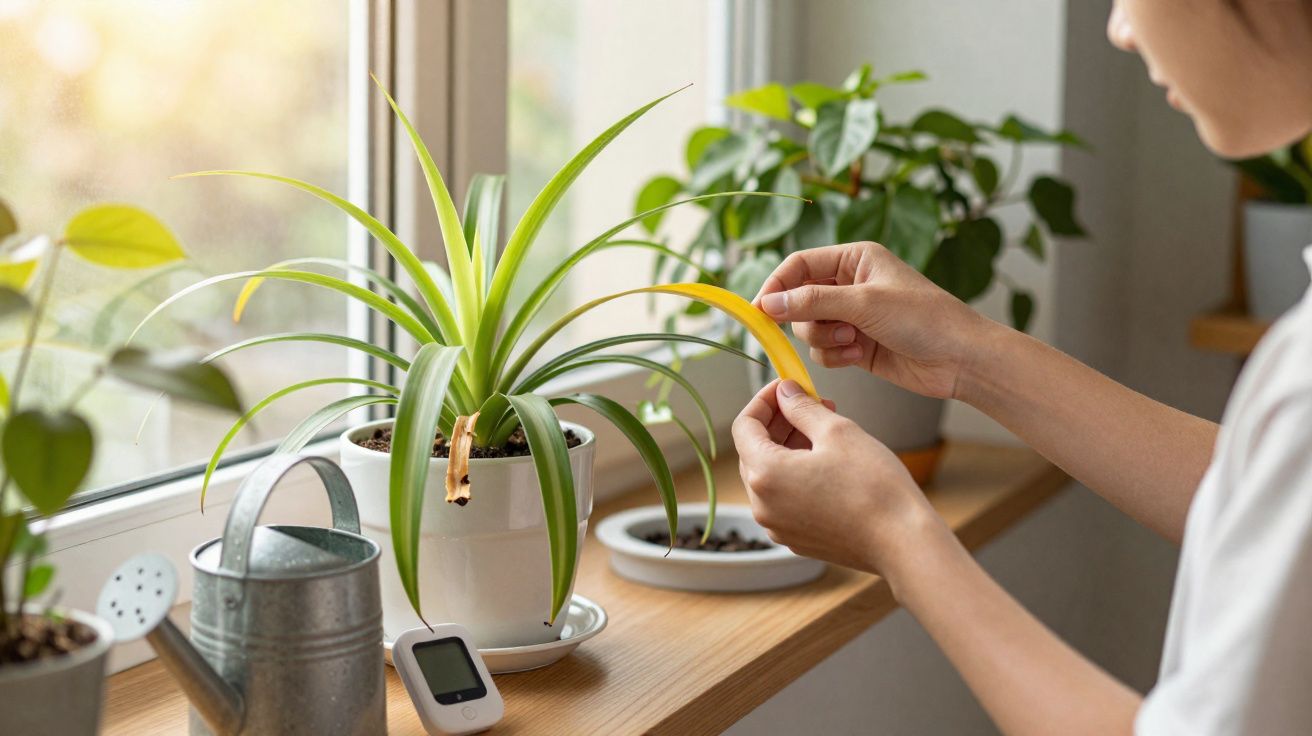
Many indoor gardeners only notice the problem once their spider plant no longer looks like a green fountain, but more like a tired hand fan. Leaves droop oddly, fold in the middle or even snap. The light is right, watering seems fine, and yet the plant still looks stressed. That is where the real detective work in the pot begins.
What a genuinely healthy spider plant looks like
A vigorous spider plant produces long, narrow leaves, usually rich green or green with a white stripe. The leaves grow densely from the centre, arch gently outwards and then fall in a soft cascade. That classic fountain shape is the clearest sign that the plant is being cared for well.
The surface should look smooth and supple. If you run a finger along a healthy leaf, you should not feel a sharp bend or any section that seems thin, soft or papery. Even very long leaves stay flexible and give slightly without snapping at once.
A useful extra clue is the way the plant sits in its pot. Healthy spider plants usually hold an even, balanced shape, with new growth emerging from the middle rather than all leaning heavily to one side. If the whole plant suddenly starts turning towards the light, it is often worth rotating the pot a little each week so the growth stays even.
Bent, yellow or dry leaves: what is really behind them
Before assuming a major care disaster, it is worth checking the simplest explanation: physical damage. A door brushes the pot, a child’s foot catches it, or the cat lands in the foliage during a leap – all of these can bend or break individual leaves without the plant being generally weak.
The pattern that should raise concern is this one: several fresh leaves emerge already misshapen, become soft, flop over or tear at the base. In that case, there is usually a care mistake behind it, most often involving water, roots or humidity.
Too much water: when the roots are nearly drowning
Spider plants are fairly forgiving, but they do not tolerate constantly wet roots for long. Common signs of overwatering include:
- leaves are bent and turn yellowish or grey-green
- the compost feels heavy, cold and damp for a long time
- the pot sometimes gives off a slightly stale smell
- new leaves emerge thin and floppy
When this happens, damaged roots can no longer move water and nutrients properly. The transport tissue inside the leaf suffers, the structure collapses, and the fountain begins to hang like a soaked cloth.
Recovery plan:
- Water again only when the top 5 cm of compost has dried out.
- Always empty saucers and never leave water standing underneath the pot.
- If the plant still feels soggy after a break from watering, gently lift the root ball out of the pot and inspect the roots.
If the roots are brown, soft and smell unpleasant, root rot is the problem. In that case, you need to act decisively: trim away rotten root sections with clean scissors, repot the plant into fresh, airy compost and water much more carefully in future.
Too little water: when leaves break like dry straw
The opposite extreme causes problems too. Spider plants can cope with short dry spells, but if they are left without enough water for too long, the leaves start to look like this:
- the tips turn brown and fray
- they snap easily and feel hard and brittle
- the compost shrinks away from the edge of the pot and cracks appear
In this case, the plant simply does not have enough water in its system. Cell walls lose tension, the leaf tissue dries out and gives way under pressure almost immediately. At this point, a single quick watering will rarely make much difference. The compost often stops absorbing water properly.
A better approach is to water the pot slowly from below. Stand it in a bowl of water until the compost has soaked through, then let it drain thoroughly. After that, water evenly rather than on a daily basis, and always check whether the root area is truly thirsty again first.
Air too dry, light too low: hidden stress factors
The watering can is not the only thing that matters. Two other common causes are:
- Dry central heating air: leaf tips turn brown, edges become ragged and small bends appear more often. A bowl of water or a tray of damp gravel under the pot can already make a noticeable difference.
- Too little light: the whole plant leans clearly towards the window. The leaves become longer, but thinner and weaker, so they bend more easily. A bright spot without harsh midday sun, such as right by an east- or west-facing window, is much better.
What to do with leaves that have already broken
There is no real hope of “self-healing” once a leaf has genuinely snapped. A sharply bent or fully broken leaf will not straighten again. The transport tissue has been damaged, so the leaf remains a dead weight on the plant.
Once a leaf has folded cleanly, the only useful solution is a clean cut – that way the energy goes into fresh growth.
Here is how to deal with it:
- Prepare clean, sharp scissors or a small pair of secateurs.
- Cut bent leaves off as low down at the base as possible.
- Leave the cut areas dry and do not water straight afterwards.
A healthy spider plant replaces lost leaves quite quickly. Removing dead material regularly also helps prevent rot and mould in the densely growing centre of the plant.
Keeping a spider plant healthy long term: a routine that prevents new bends
To stop the drama of twisted leaves from happening again and again, a simple care checklist is worth having. A small notebook or a note on your phone can help you record watering dates, changes of position or repotting sessions. That makes it much easier to spot links between what you have done and how the leaves are responding.
It also helps to check the pot size and drainage from time to time. Spider plants do best in a container with proper drainage holes and compost that stays airy, not compacted. If roots fill the pot tightly, growth can become weak and the leaves may suffer sooner from irregular watering.
| Problem | Typical signs | Action |
|---|---|---|
| Too much water | soft, yellowish leaves, wet root ball | Leave longer between waterings, use a pot with drainage holes, loosen the compost |
| Too little water | brittle brown tips, compost pulling away from the edge | Water thoroughly, then allow it to dry out again |
| Rotten roots | stale smell, brown roots, limp plant | Cut back roots, repot, improve drainage |
| Air too dry | brown edges, tiny cracks | Water tray, humidifier, keep away from radiators |
| Too little light | plant leans towards the window, thin leaves | Move to a brighter spot, not a dark corner |
How to spot care mistakes early
The sooner you respond, the fewer leaves you will lose. Check the plant each week for small warning signs:
- discolouration at the leaf tips
- slight ripples or folds along the leaf edges
- individual leaves that feel much softer or much firmer than the rest
- changes in growth: sudden leaning or clearly wider gaps between the leaves
These clues often point to an imbalance in water supply or light long before whole leaves bend or break. If you adjust watering, position and humidity at this stage, you can usually avoid serious damage altogether.
Another useful habit is to look at the plant at different times of day. A spider plant that looks healthy in the morning but limp by evening may be reacting to heat, direct sun or a drying room. Spotting that pattern early can save you from repeating the same mistake.
Why spider plants forgive so much - up to a point
Spider plants are among the tougher houseplants. They cope well with tap water, tolerate fluctuating temperatures and can still grow reasonably well in middling light. But that resilience has a downside: many owners underestimate the warnings because the plant keeps going bravely at first.
That means the leaves often bend only after something has been wrong for quite a while. For that reason, it is worth looking closely rather than relying on the plant’s reputation for being easy-care. Anyone who waters on a loose schedule, checks the compost in between and avoids constant moves to new positions will still rarely have serious trouble with spider plants.
The same basic rules also apply to other popular houseplants, such as spider plant relatives, peace lilies or smaller palm species. In every case, leaves with bends, breaks or dry edges tell you a great deal about the water, air and light in the room. Once you understand that language, you will spare yourself many dried-out pots on the windowsill.



Comments
No comments yet. Be the first to comment!
Leave a Comment