
It’s an oddly familiar little crisis: you’re in the kitchen at 6.37pm, staring at a mournful, brick-hard lump of frozen mince on the worktop and wondering how you’ve ended up here again. You swore you’d be more organised this week - the sort of person who calmly moves tomorrow’s dinner into the fridge the night before - and yet you’re now tapping a chicken breast that could double as a doorstop.
Your eyes drift towards the microwave. The defrost button sits there like a promise you already know you’ll accept.
You tell yourself you’ve got away with it before, so it’ll probably be fine. The machine whirs, the turntable rotates, and soon the edges look tired and grey while the middle remains stubbornly icy. That’s when the nagging thought arrives: am I about to give everyone food poisoning? Most people aren’t taught a genuinely quick, genuinely safe method - but there is one. Once you learn it, the microwave’s defrost function starts to feel less like a shortcut and more like the troublemaker.
The romance - and the rage - of the microwave defrost button
On paper, the microwave defrost button is a domestic miracle: press once and dinner is supposedly rescued from your own poor planning. In reality, it rarely looks like the adverts. You get half-warmed corners, rubbery bits, and that faint smell of chicken skin that’s been pushed a touch too far.
We keep using it because it flatters us. It suggests we can go from freezer to frying pan in minutes with no downside. The problem is that defrost programmes deliver energy unevenly: some parts stay frozen while others are nudged into the warm band where microbes thrive.
Food scientists call that band the temperature danger zone, roughly 5°C to 60°C. In that range, bacteria such as salmonella and E. coli can multiply fast - sometimes doubling in about 20 minutes. When the microwave warms the surface while the centre is still solid ice, the outside can sit in that risky zone for longer than you’d like, even though it looks harmless.
Why the middle stays frozen while the outside turns grey
Microwaves heat food by exciting water molecules, and that energy doesn’t distribute neatly through thick, dense, frozen meat. The thinner edges thaw first, corners can start to steam, and the centre behaves as if it’s still in the Arctic. The end result is a strange patchwork: hot spots, lukewarm areas and a frozen core.
As soon as the outer layer reaches a “warm-ish” temperature, dormant bacteria can become active again. Freezing slows them down; it doesn’t erase them. Thorough cooking will kill most pathogens - but there’s an extra complication: if bacteria have had enough time in the temperature danger zone, some can produce toxins that aren’t reliably destroyed by heat. You won’t taste them, but your stomach will.
There’s also a behavioural trap. Meat that’s been microwaved to “defrost” often looks partially cooked on the outside, which makes it easier to undercook it properly afterwards. When people are hungry, they rush: a quick fry, a shorter grill, a “that’ll do” moment - and the defrost button makes that kind of corner-cutting feel reasonable.
The fridge method we all claim to use (and regularly don’t)
Ask any food safety professional how to defrost meat and you’ll hear the same answer: do it in the fridge. They’re not wrong. The refrigerator keeps temperatures low, thawing is gradual, and bacteria don’t get that cosy window they’re waiting for.
In a perfect world, you’d move tomorrow’s chicken from freezer to fridge in the morning, then cook it in the evening like a serene, fully functioning adult. Real life, however, is chaotic: late trains, last-minute plan changes, children announcing surprise guests, and the sudden discovery that nothing is ready to cook.
Fridge thawing also demands planning 12–24 hours ahead, which can feel faintly bleak when your week is already a blur of meetings, school bags and alarms. You open the fridge, find nothing thawed, and end up resenting the optimistic version of yourself who bought the food in the first place.
The quiet guilt of good intentions
We all know an “organised food person” online: labelled tubs, tidy meal prep, immaculate freezer stacks. They remember to thaw things. They probably also put washing away the same day it dries.
For everyone else, thawing meat often becomes damage control: how do I make this safely edible before someone gives up and pours cereal again? That’s where the low-level guilt appears - you know the fridge method, you ignore it, and you end up watching the microwave spin as though you’re keeping a mildly embarrassing secret.
There is, though, a middle option between saintly fridge planning and chaotic microwaving. It’s not flashy. It requires a sink (or bowl), a bag, and a bit of patience - and it works.
Cold water thawing for meat: the unglamorous hero of fast defrosting
Cold water thawing sounds almost too basic to compete with modern gadgets, like a tip your gran would offer while you roll your eyes. Yet in food safety circles, it’s widely regarded as the best “real-life fast” method: quick enough for a weekday evening, controlled enough to keep you away from the temperature danger zone, and surprisingly straightforward once it’s routine.
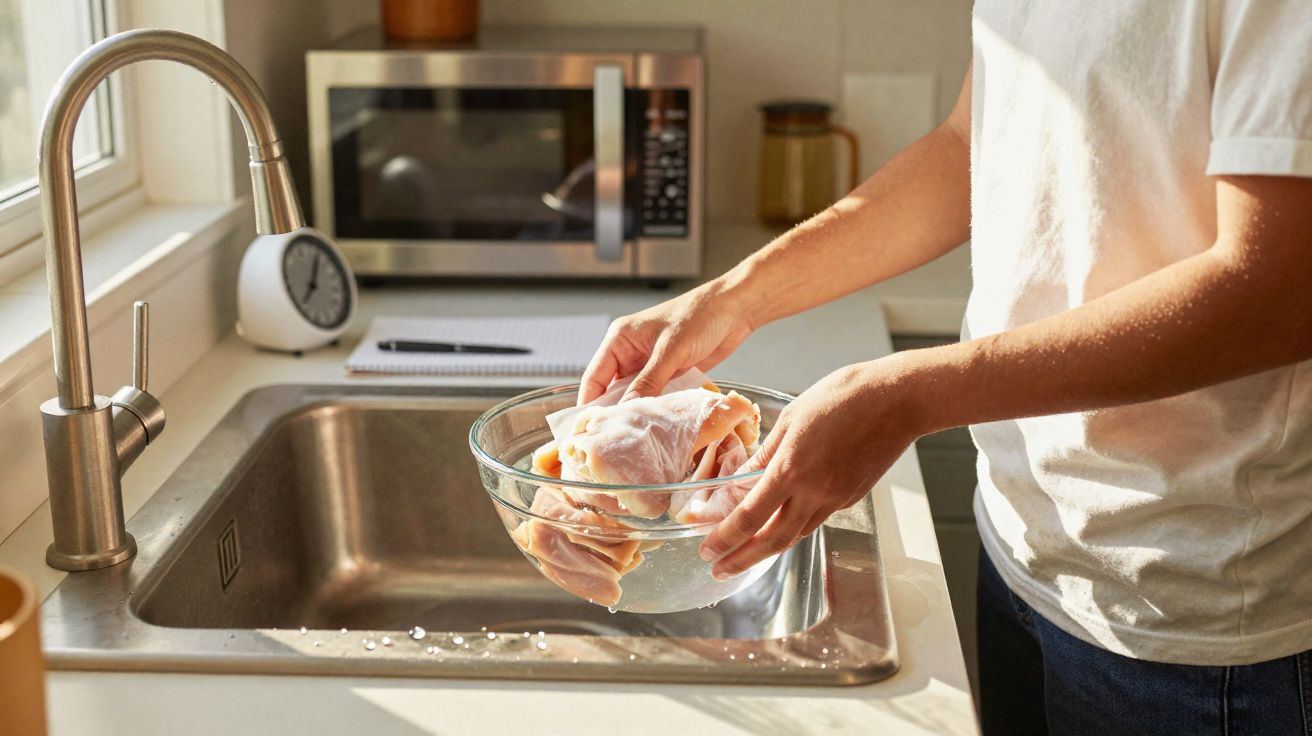
Here’s the principle: keep the meat in a leak-proof bag, submerge it in cold tap water, and change the water every 30 minutes so it stays cold. Water transfers heat far more efficiently than air - even the cold air in a fridge - so thawing is dramatically faster.
That chicken breast that might take the best part of a day in the refrigerator can go from frozen to cookable in roughly an hour in cold water. Smaller items are quicker still. A 500g pack of mince often loosens up in 30–40 minutes - roughly the time it takes to empty the washing machine and negotiate who gets the remote.
Why cold water beats the microwave at its own game
Cold water helps keep the surface of the meat cooler for longer, reducing the time it spends edging towards the temperature danger zone. Instead of unpredictable bursts of heat, you get a steadier, more even thaw. No half-cooked grey rims, no odd hot patches - just a gradual shift from rock-solid to pliable.
It also needs to be cold water, not warm. Hot or even warm water can thaw the outside far too quickly, pushing it into bacteria-friendly temperatures while the centre is still frozen. Cold tap water feels slower, but it’s the reason the method is both fast and safer.
There’s a calming rhythm to it, too: fill the sink or bowl, submerge the bag, tip out and refresh the water every half hour. No frantic beeping, no aggressive humming - just a practical little ritual that keeps dinner moving in the right direction.
How to do cold water thawing without turning your kitchen into a swamp
Cold water thawing is simple, but a few details really are non-negotiable:
- Seal the meat in a leak-proof bag. If the supermarket packaging isn’t watertight, put it inside a freezer bag or zip bag before it goes anywhere near water. You don’t want raw juices leaking out into the sink.
- Use a clean sink or a large bowl and make sure the meat stays fully submerged. If it floats up like an irritating iceberg, hold it down with a plate.
- Change the water every 30 minutes. This isn’t fussiness - it prevents the water warming up as the meat thaws, which helps limit time spent near the temperature danger zone.
- Cook immediately once thawed. Don’t leave it “for a bit” on the side while you scroll. You’ve sped up the thawing; now you need to move straight to proper cooking.
One extra, often-missed point: treat the sink area like a raw-meat zone. After you’re done, wash the bowl/sink and surrounding surfaces with hot, soapy water, and clean any taps or handles you touched with wet hands.
A rough guide for real evenings (not imaginary perfect ones)
You don’t need military precision - just a workable sense of timing.
- Smaller cuts (chicken fillets, boneless pork steaks, 500g mince packs): usually 30–60 minutes
- Larger pieces (up to around 1kg): can take up to 2 hours
- Big joints and whole chickens: often several hours, and are usually better suited to fridge thawing if you can plan ahead
If you’re liable to forget what’s in the sink, set a phone timer for each 30-minute water change. The goal isn’t perfection; it’s to stop the water drifting into lukewarm territory while you’re busy supervising homework, showering, or searching for missing football boots.
Two upgrades that make safe defrosting even safer
First, consider using a food thermometer when you cook, especially for poultry and mince. Safe thawing reduces risk, but proper cooking is what finishes the job - and guessing by colour alone isn’t always reliable. A thermometer removes the doubt that can hover over a rushed midweek meal.
Second, keep portions sensible. If you routinely freeze meat in smaller, flatter packs (rather than one thick lump), both fridge thawing and cold water thawing become faster and more even. It’s a tiny bit of effort on shopping day that pays you back when you’re hungry at 6.37pm.
The emotional side of “doing food safely”
Food safety guidance can feel like yet another standard you’re meant to meet flawlessly, alongside recycling rules and replying to emails at a respectable speed. Most households operate on “good enough”, particularly on a Tuesday night when everyone’s tired and impatient - which is exactly why the microwave defrost button feels so seductive. It offers a one-press solution to a problem you’d rather not have.
Cold water thawing doesn’t have gadget glamour. It’s closer to slow, steady competence. You’re not crossing your fingers and hoping the microwave behaves; you’re actively keeping things under control. That little sense of agency matters, especially when the rest of life is notifications and last-minute changes.
And it reduces that background worry many people know too well: sitting down to eat and thinking, did I rush that chicken? When thawing is controlled and cooking is thorough, the anxiety drops away - even if you still manage to burn the onions.
So, should you break up with the defrost button?
Nobody is going to burst into your kitchen and confiscate the microwave. There will be genuine emergencies where the defrost button feels like the only way dinner happens, and many people have muddled through years of questionable thawing with nothing worse than a dodgy stomach.
But once you understand how uneven microwave thawing can be - and how easily it can hold the surface in the temperature danger zone - it’s hard to see it as harmless. The fridge remains the dependable, boring option. Cold water is the practical friend who helps you out quickly without the drama. The microwave’s defrost function is the charming ex: convenient, persuasive, and not particularly good for you over time.
Next time you catch yourself reaching for the keypad, pause. Grab a bag, fill a bowl or the sink with cold water, and let cold water thawing do the quiet work. Your meat will defrost more evenly, the risk will drop, and you won’t be left with those grey, half-cooked edges that smell faintly of regret. Your future self - and everyone at the table - will notice.




Comments
No comments yet. Be the first to comment!
Leave a Comment