
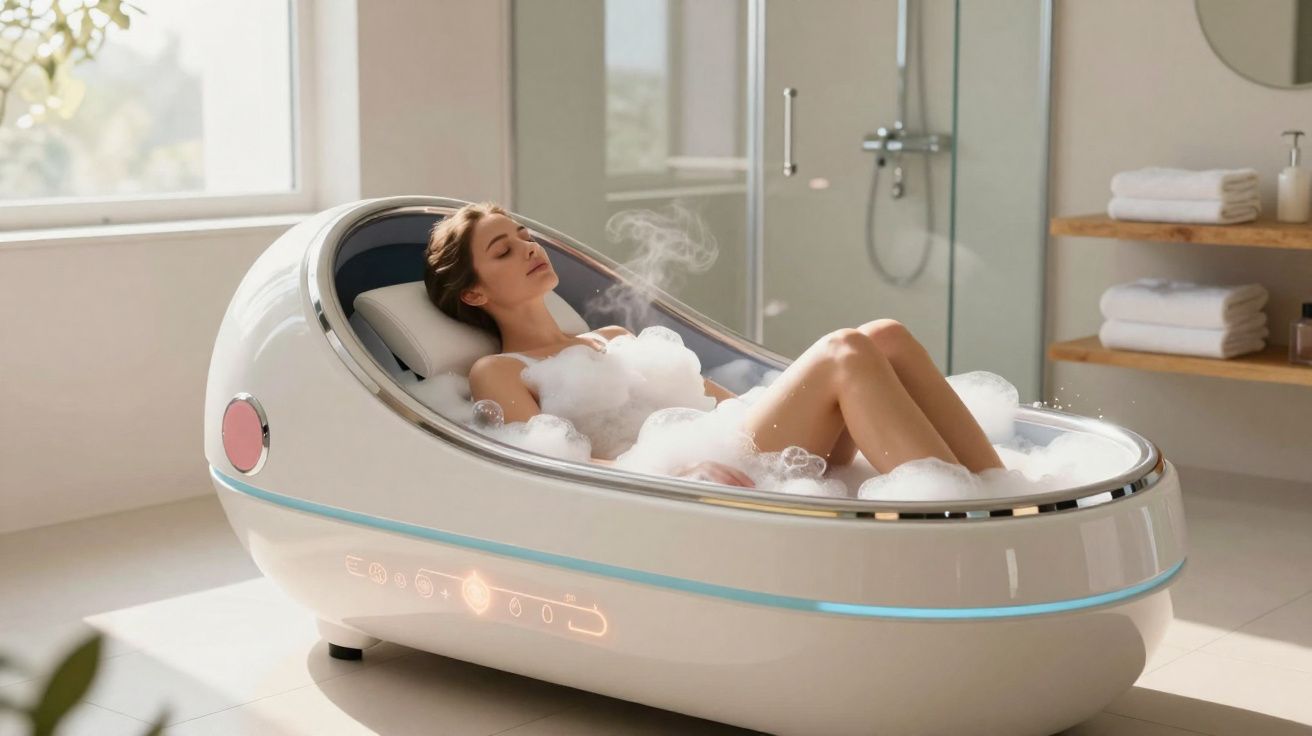
In Japan, a futuristic washing capsule is currently making headlines: it is designed to clean and dry the entire body in just a few minutes - fully automatically, with artificial intelligence and a built-in wellness element. The concept sounds like science fiction, but it could soon call the traditional shower enclosure in modern bathrooms into question.
The idea: washing in a human washing machine
The system is being developed by the Japanese company Science Co. in Osaka. The machine is called Mirai Ningen Sentakuki, which loosely translates as a kind of human washing machine for the future. Visually, it resembles a sealed, walk-in capsule in which users sit comfortably.
The process sounds wonderfully straightforward: step inside, close the door, take your seat - the machine does the rest.
- The water supply starts automatically
- Billions of microbubbles clean the skin
- Sensor data control temperature, pressure and lighting
- Integrated drying makes towels unnecessary
The entire cycle is expected to take around 15 minutes. After that, the promise is that you step out clean, dry and noticeably more relaxed.
The human washing machine: how the microbubble cleaning works
At the heart of the system is a water technology that uses extremely fine air bubbles. These microbubbles circulate through the capsule and settle on the surface of the skin.
The tiny bubbles are meant to loosen dirt particles and sebum from the pores, without the user needing to scrub or rub.
Microbubble systems are already used today in wellness baths and specialist spa treatments. This new capsule packages the principle into a fully automated everyday appliance. The aim is a thorough yet very gentle clean that is also intended to be kind to sensitive skin.
Spa experience instead of a rushed shower
The developers want to do more than simply wash the body; they want the whole routine to feel like a miniature spa visit. To achieve that, Science Co. has built in several layers of technology:
- Biometric sensors measure heart rate and other bodily data
- An AI system evaluates the readings in real time
- Water and air pressure adjust to the user’s physical condition
- Lighting and sound can be controlled for relaxation or re-energising
Someone who climbs in feeling stressed is meant to be met with dimmed lighting, gentler water flow and calming sounds. Someone who wants to wake up in the morning may instead receive brighter light and stronger water pulses. The machine is designed for an experience closer to a personalised spa treatment than to an ordinary no-nonsense shower.
Health in focus: what the capsule measures
The concept becomes especially interesting where hygiene and health monitoring overlap. Throughout the washing cycle, the system continuously collects body data and can identify patterns.
In the long term, the capsule is intended to provide indications of stress levels, recovery state and changes in important vital signs.
It is being considered for use by:
- older adults who want to keep an eye on their readings regularly
- people with cardiovascular conditions
- anyone with a highly stressful lifestyle who wants to understand their body better
At the moment, this is still a development project, but the vision goes much further: one day, the data could be sent to health apps or to a treating doctor so that trends can be spotted early - for example, a persistently elevated pulse, unusual recovery patterns or prolonged stress phases.
For any such system to work in daily life, it would also need to be practical to maintain. Filters, nozzles and interior surfaces would have to be easy to clean, and users would need simple emergency stop or exit functions. Those details often determine whether a futuristic idea remains a novelty or becomes a genuinely usable piece of bathroom equipment.
Drying without a towel: a complete cycle in 15 minutes
After cleaning, the drying phase begins without interruption inside the same capsule. An internal system blows warm air around the body and is meant to remove moisture from the skin quickly.
According to the information available so far, the complete cycle - from stepping in to stepping out - takes about a quarter of an hour. Towels, a hairdryer or a bathrobe are not needed in theory. For people with limited mobility, such as older adults, that could be a major advantage: less risk of slipping, no bending down and no rubbing dry.
Farewell to the shower enclosure? What could really change in the bathroom
Of course, the classic shower enclosure is not about to disappear tomorrow. Still, the project shows how strongly the role of the bathroom may be changing. It is becoming less about pure body care and more about a combination of:
- hygiene
- stress reduction
- digital health checks
Where a shower head, tap and glass door once sufficed, words such as sensors, AI and personalised programmes are now entering the picture. The bathroom is becoming a high-tech zone in which wellness, care and data analysis meet.
Who would a capsule like this actually suit?
There are still many unanswered questions: price, space requirements, maintenance, and water and electricity consumption. What is clear, however, is the type of customers the manufacturers are likely targeting:
- Luxury hotels and spa areas that want to offer guests a striking unique selling point
- Care homes, where staff can save time and residents can be washed more safely
- Tech-savvy households looking to extend their smart home all the way into the bathroom
For small city flats with cramped bathrooms, the capsule is unlikely to be realistic at first. In new-build homes or high-end wellness bathrooms, however, it could arrive sooner than many people expect.
Retro-futurism: the idea is older than many people think
The dream of an automatic body-washing machine is not entirely new. An earlier prototype was already on display at the Osaka Expo in the 1970s. At the time, the concept failed because of technological limits and cost.
Today the conditions are different: sensors are cheaper, computing power is available in compact form, and wellness has a far higher social value. The current capsule therefore brings an old vision to life with modern technology - and finds an audience that is already used to smart everyday helpers.
Opportunities, risks and open questions
The advantages are obvious: less physical effort when washing, more comfort, programmes tailored to the individual and a closer connection to personal health. People with disabilities or older adults in particular could benefit greatly from such a solution.
At the same time, several concerns remain:
- Data protection: Where does the collected vital data go, and who analyses it?
- Dependence on technology: What happens if there is a fault or software error mid-cycle?
- Resource use: Is the capsule really more efficient than a well-designed shower?
- Acceptance: Will users feel comfortable inside a closed capsule, or will it cause unease?
There is also the question of whether a machine should take over body care completely. Many people see showering as a brief moment just for themselves, a ritual shaped by habit. A fully automatic solution could change that feeling - for better or for worse, depending on the person.
How realistic is everyday life with the human washing machine?
Realistically speaking, the traditional shower enclosure will continue to dominate bathrooms in German-speaking households for a long time yet. At the moment, the new technology feels more like a glimpse into the premium hotels of tomorrow or into care facilities with a high level of digitalisation.
It will be interesting to see how individual elements of the capsule develop on their own. Health-monitoring sensors, for example, could make their way into ordinary shower systems. Intelligent lighting and sound concepts can already be integrated relatively easily today. In that case, fully automated seated body washing would remain the luxury end of this development.
For anyone planning a new bathroom in a few years’ time, one question will come up more often: do I really only need a simple shower enclosure, or should the room also serve as a wellness area, health station and technology playground? That is exactly where the human washing machine comes in - and it is already prompting people to think about the bathroom in an entirely new way.




Comments
No comments yet. Be the first to comment!
Leave a Comment