
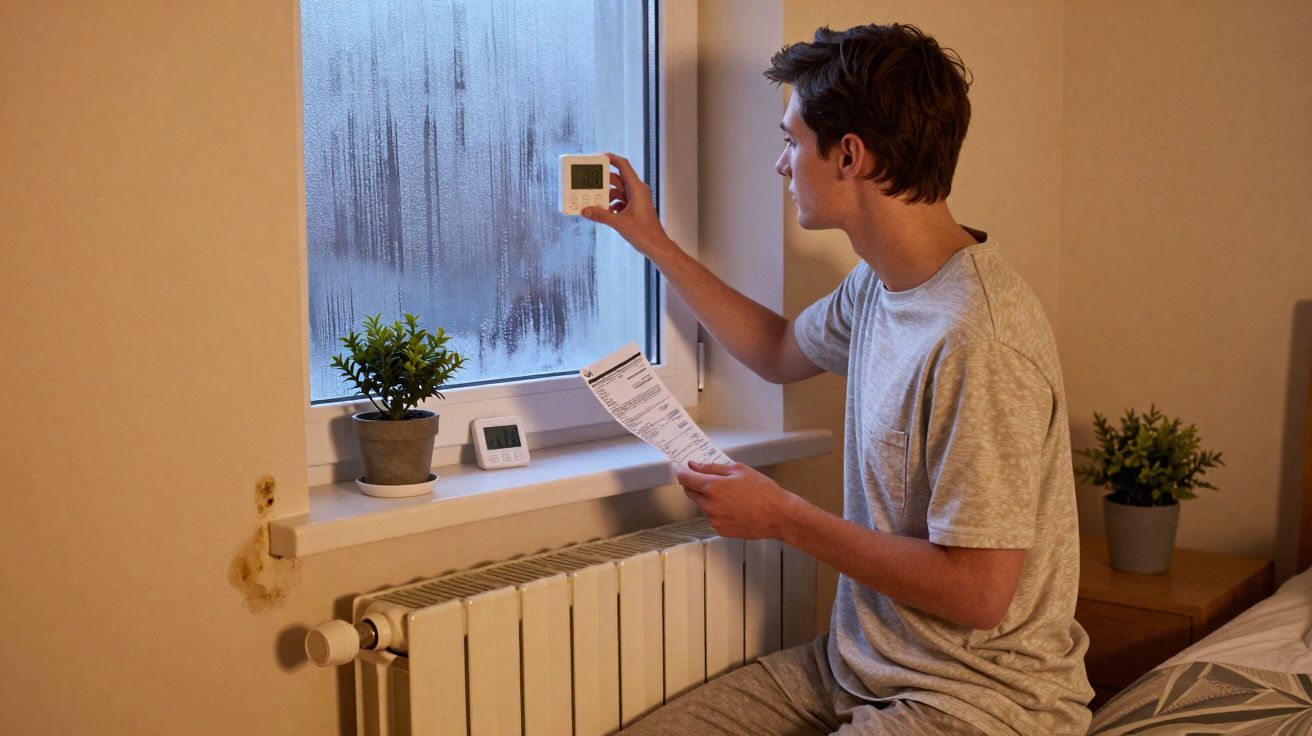
Many households turn the heating off completely overnight to save money, only to be surprised by a larger annual bill later on.
With energy prices still high, the idea sounds tempting: heating off, blanket on, savings made. Yet what appears sensible at first glance can have the opposite effect. Experts warn that overdoing it can push consumption up - and can even damage the flat.
Why turning the heating off at night often backfires
A common routine is to switch the heating off and then crank it up again in the morning. Even so, this behaviour often shows up on the bill as a genuine cost driver. The reason lies not only in air temperature, but in the physics of the building itself.
If the heating stays off for hours, it is not just the rooms that cool down. Walls, floors, ceilings and furniture lose heat too. These components act like a huge cold sponge that has to be “recharged” all over again in the morning.
The colder a room gets, the more energy is needed to warm it back up again - in some cases by as much as 20 per cent.
This is especially noticeable in poorly insulated flats, where temperatures can drop quickly overnight. If the heating is then turned up strongly in the morning, it creates a real energy surge. In many cases, that surge wipes out the supposed saving altogether.
How much should the temperature drop at night?
Instead of switching the heating off entirely, energy specialists recommend lowering the temperature in a targeted way. Bedrooms do not need to be as warm as a living room at night, but they should not feel like a fridge either. For most people, a range of 16 to 17 degrees in the bedroom is a good compromise between comfort and energy use.
During the day, living areas may be a little warmer, and the bathroom a little warmer again. As a rough guide, a home with a conventional central heating system might follow the temperatures below:
| Room | Daytime temperature (°C) | Night-time setting (°C) |
|---|---|---|
| Bedroom | 16–18 | 16 |
| Living room | 19–21 | 17 |
| Bathroom | 22 | 17 |
| Kitchen | 18–20 | 16 |
The point is not to treat the figures as rigid rules. People who feel the cold will usually prefer the upper end of the range, while those who are comfortable in cooler conditions may be happy lower down. What matters is keeping the day-to-night difference moderate.
Night-time heating: set it lower rather than switching it off
The most effective way to manage a controlled night-time reduction is with a programmable thermostat. It automatically lowers the flow temperature when it is time to sleep, then brings the heating back up in good time before the alarm goes off.
Smart control prevents extreme temperature swings - and it is exactly those swings that drive energy use up.
Such a device offers several benefits:
- Steady base temperature: The rooms do not cool down completely, and walls and furniture remain lightly warmed.
- Predictable reduction: Times for work, holidays or weekends can be set in advance.
- Less manual effort: No daily adjustment of every radiator, and no risk of forgetting.
- More comfort: Mornings feel pleasant and warm without heating the home heavily all night.
In many older properties, a straightforward electronic controller on the central heating is enough. In newer homes, smart thermostats that can be operated through an app are often used instead.
It is also worth checking that thermostatic radiator valves are working properly. If they stick or respond slowly, the heating system may react too late or too strongly, which can undo much of the benefit of a sensible night-time setting.
Heating system, building fabric and habits all interact
Whether turning the heating off actually pays off in your home depends on several factors. The three most important are:
1. The insulation standard of the property
In well-insulated homes, temperatures fall only slowly. A reduction of two to three degrees overnight will usually allow the home to return to normal without extra consumption. In older, unrenovated buildings, heat escapes much more quickly. The rooms cool down further, and reheating them becomes an energy trap.
2. The heating system and its responsiveness
Underfloor heating reacts slowly. It releases heat evenly over many hours. If it is switched off completely, reheating takes a long time and uses a great deal of energy. Traditional radiators are quicker, but even there, large temperature changes create high peaks in demand.
3. Your personal usage pattern
Someone who comes home late, leaves early and barely uses the flat during the day can reduce the temperature more than someone who works from home all day. Broad rules are of limited use; an honest look at your own routine is far more helpful.
When switching the heating off completely can make sense
There are situations where a full shut-off is genuinely reasonable - just not every night.
- Several days away: When travelling or taking a weekend trip, many homes can be reduced to around 12 to 14 degrees. That helps protect pipes from frost, keeps the building fabric reasonably warm and saves a noticeable amount of energy.
- Very well-insulated houses: In modern new-builds with high-quality insulation and controlled ventilation, rooms lose heat only slowly. In these homes, a stronger night-time reduction can work without the costs shooting up in the morning.
- Spring and autumn transition periods: If daytime temperatures are mild and only the nights are cool, the heating in individual, rarely used rooms can sometimes stay off completely for a while.
Even so, anyone who switches the heating off entirely should keep an eye on the temperature. If it drops well below 16 degrees for a prolonged period, there is not only the risk of higher consumption later on, but also the possibility of damp problems.
Mould risk: too cold is more than just uncomfortable
Low room temperatures reduce how much moisture the air can hold. Cooking, showering and breathing all add water to the home. If the surfaces are cold, that water vapour settles on walls and windows.
Where condensation keeps forming, mould soon follows - especially in corners and behind furniture.
If you switch the heating off completely at night and only turn it up briefly in the morning, you risk exactly this effect. Cold external walls remain damp, even if the air is warmed up again for an hour or two. In the long run, that can damage both your health and the structure of the building.
A simple way to reduce this risk is to keep indoor humidity in a sensible range and make sure air can circulate freely. In most homes, good ventilation combined with moderate heating is more effective than trying to “air out” moisture with a permanently cold room.
Practical tips for lower heating bills without a cold shock
Rather than switching everything off abruptly, it is better to combine a number of smaller measures:
- Keep radiators clear: Do not place thick curtains or furniture directly in front of them. Heat needs space to circulate.
- Ventilate briefly and properly: Open windows fully for five minutes several times a day and turn the heating down briefly - this is more efficient than leaving windows on the tilt for hours.
- Seal draughts: Sealing strips on old windows and doors reduce cold air leaks and cut the need for heating energy.
- Bleed radiators: Gurgling radiators deliver less output. Regular bleeding improves efficiency.
- Choose realistic temperatures: Every degree lower saves roughly four to six per cent of heating energy - without forcing you to sit on the sofa in a parka.
It also helps to check curtains, door gaps and radiator placement at the start of the heating season. Small obstacles can stop heat spreading properly, which means the system works harder than necessary for the same level of comfort.
Why the annual bill can be misleading
Many households try out different strategies over the winter and then rely on instinct later: “I switched it off more often this year, yet the bill was still high.” The problem is that weather, energy prices and service charges all change from one year to the next. A direct comparison is therefore misleading.
A better approach is to stick consistently over an entire heating season to moderate night-time reduction, sensible temperatures and a few behavioural changes, then compare consumption in kilowatt-hours. That figure reflects the real energy requirement much more accurately than the final amount on the bill.
How to find the right strategy for your home
If you are unsure, try testing two different approaches over two consecutive weekends: once with the heating completely off overnight, and once with a reduction of around three degrees. A simple room thermometer and the reading on the heating system will already show how much the rooms cool down and how long reheating takes.
Smart heating apps or digital meters can also help, because they show consumption over specific periods. That makes it easier to see which strategy really saves energy in your home - and which one only feels cheaper but ends up costing more.





Comments
No comments yet. Be the first to comment!
Leave a Comment