
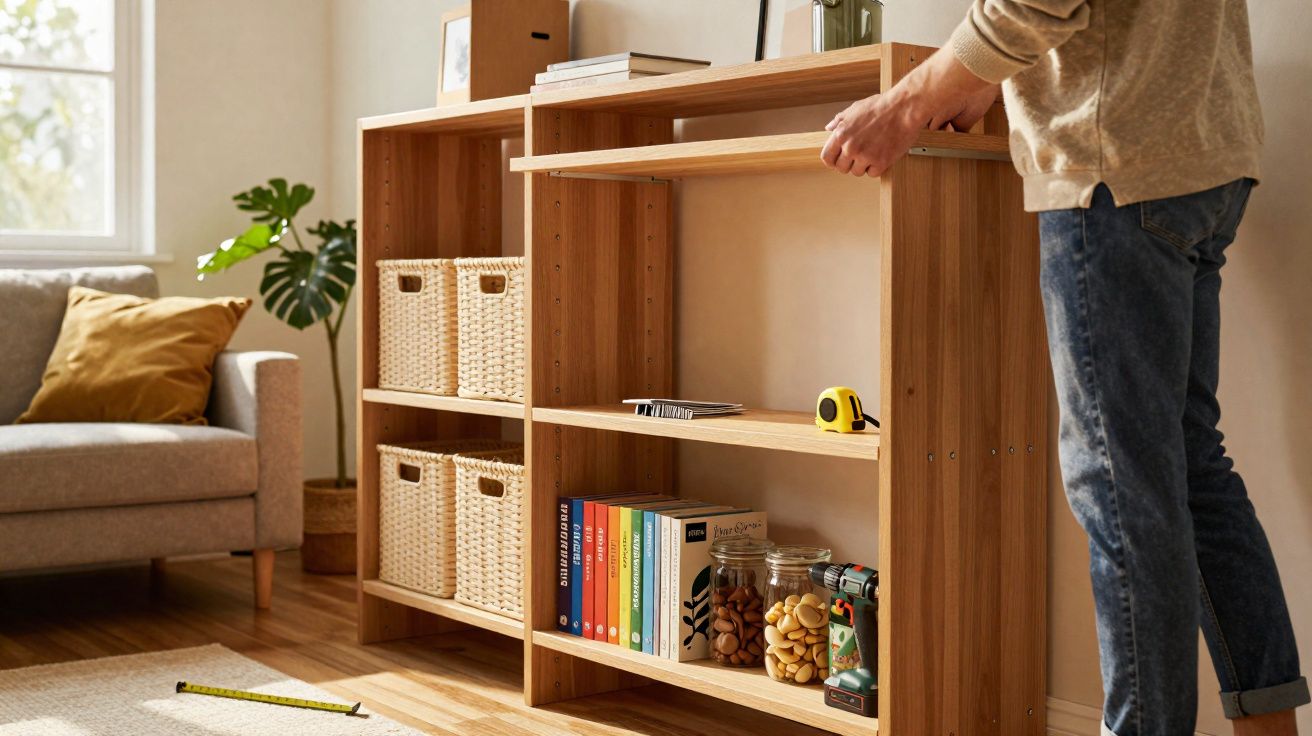
The row began over a cereal box. He insisted they’d picked it up just two days earlier. She was adamant there hadn’t been room for it on the shelf. Somehow, they were both telling the truth. The pantry was crammed: half-open packets, long-forgotten jars, and those unlabelled tubs nobody wants to investigate. Familiar?
You open a cupboard and something’s always poised to tumble out. It’s rarely because you own “too much”. More often, it’s because the storage has stayed exactly the same while your life has moved on.
One small change can unstick the whole situation - and it isn’t what most people assume.
The small adjustment that quietly changes everything
Watch anyone open an overstuffed cupboard and there’s a telltale beat: eyes dart, shoulders drop, something gets shoved sideways to make room. That little pause is the price of a poorly designed storage area. Your belongings aren’t the issue. The shelves are.
In most homes, shelves are fixed at a single height, set once and left alone because “that’s where the builder put them”. The simplest upgrade isn’t another plastic tub or a new label-maker. It’s this: decide that your shelves are temporary.
Treat shelf height as negotiable. Move shelves. Add more pin holes. Fit adjustable brackets or rails. Make every level open to revision.
A kitchen doesn’t stay the same, so why should the shelving? Early on, the lower shelves might be packed with plastic plates and snack boxes. A couple of years later, the toddler has grown and the snack shelf needs to shift higher. Then you hit the bulk-buy stage, the baking stage, the smoothie stage. Each new routine brings different shapes and sizes of items. With adjustable shelves, the room can be reconfigured in about 20 minutes on a quiet Sunday.
Without that flexibility, everything ends up layered in front of everything else - and that’s when a cereal box turns into a household argument.
The reason this one tweak works is straightforward: most storage gets designed once, then locked in place for a decade. Real life doesn’t behave like that. Hobbies change, children grow, groceries arrive in bulk during promotions and vanish after a “we’re not doing that shop any more” decision. Fixed shelves force you to reshape your habits around the furniture. Adjustable shelves let the furniture reshape itself around your habits. That’s the whole point.
As soon as shelf height can change, wasted vertical air becomes usable space. Deep cupboards stop eating items. And you stop “losing” things you already own.
How to set up flexible storage at home (with adjustable shelves)
Begin with one cupboard or wardrobe - not the entire house. Open it and take a quick photo on your phone. Empty it completely so you can see the framework. Then ask: where is the trapped air?
- Above short jars
- Under hanging coats
- Behind rows of shoes
Now make the small adjustment: add or reposition a shelf so no vertical gap is taller than it needs to be. If possible, fit rail systems with holes every few centimetres so you can change positions easily. If you can’t alter the unit, use freestanding shelf risers inside the cupboard to split the height.
At this stage, you’re not “organising”. You’re rebuilding the stage so organising is possible.
Many people stall right here. They start with energy, buy bins and labels, then stop because the setup feels too rigid to maintain. And honestly: nobody keeps a perfect system every day. Real life includes late finishes, ill children, and weeks where everything gets shoved in “for now”.
That’s why overly precious systems fail. A flexible storage approach forgives you. When a category grows, you simply nudge a shelf up one notch. When a seasonal hobby shrinks, you move that shelf higher and reclaim the prime space at eye level. We all know the moment you vow to “declutter for good” and then life immediately proves you wrong.
A quick safety note (often overlooked)
Before you start shifting shelves around, check what you’re asking them to hold. Heavier items (tins, appliances, bulk bags) belong on lower levels, and shelves should sit securely on properly rated supports. If you’re adding extra holes or rails, measure carefully and keep the shelf level - a slight tilt can make items creep forward and fall when the door opens. Flexible storage works best when it’s also stable storage.
A small upgrade that amplifies the result
If your cupboard is dark, clutter feels worse because you can’t see what you own. Consider adding stick-on LED lights (battery or rechargeable) inside deeper units. Better visibility reduces duplicate purchases and makes it easier to keep items in their landing zones - especially in pantries, hall cupboards, and under-stairs storage.
“When I stopped treating my cupboards like fixed architecture and started treating them like Lego,” says Anna, a 38-year-old nurse in Manchester, “I finally felt on top of my space. I move one shelf and it’s like I’ve ‘found’ half a cupboard I thought had disappeared.”
- Fit brackets, rails, or pegboard-style systems so shelves move without fuss.
- Keep one “floating” shelf in each room that can change purpose every few months.
- Place light, often-used items between waist and eye level.
- Save the very top and very bottom for bulky items or things you use rarely.
- Once each season, revisit one storage zone and adjust just one shelf height.
A home that can change its mind as fast as you do
When you start viewing storage as adjustable, the house feels less controlling. The hall cupboard can act as a winter sports locker, then switch to a summer travel station. The spare-room wardrobe can hold craft boxes this year and baby clothes next year. Your storage stops being a “final decision” and becomes a living, editable layout.
It also lifts a quiet layer of guilt. Those piles on the floor are often just the result of awkward shelf spacing - items with nowhere sensible to land. Give them a realistic home and they settle down. You don’t suddenly become a minimalist; you simply make space that matches how you actually live.
The blunt truth is that many clutter problems are design problems disguised as personality flaws.
| Key point | Detail | Value for the reader |
|---|---|---|
| Adjustable shelves | Add rails, extra holes, or risers to change shelf height | Converts wasted air into usable space without buying a larger unit |
| One-zone-at-a-time approach | Tackle a single cupboard or wardrobe per session | Keeps it manageable, prevents overwhelm, and creates quick wins |
| Seasonal reshaping | Revisit shelf positions every few months | Keeps storage aligned with real life as habits, hobbies, and families shift |
FAQ
- Question 1: What’s the cheapest way to make existing shelves adjustable?
Often, it’s enough to add metal support rails with pre-drilled holes and rest shelves on new pegs, or to use stackable shelf risers inside the cupboard you already have.- Question 2: Do I need to buy matching boxes and containers for this to work?
No. Matching containers can look tidy, but the real change comes from adjusting shelf height and depth so your current items genuinely fit.- Question 3: How often should I adjust my storage areas?
Think seasonally: every 3–4 months, or whenever a major life change happens, such as a new job, a new baby, or a new hobby.- Question 4: What if I rent and can’t drill into walls or cabinets?
Choose freestanding bookcases with adjustable shelves, over-door organisers, tension rods, and stackable cubes you can rearrange without tools.- Question 5: Where should I start if my whole house feels cramped?
Start with the daily “pain point”: the entrance area, the pantry, or the wardrobe you open every morning - then adjust just one shelf there first.



Comments
No comments yet. Be the first to comment!
Leave a Comment