
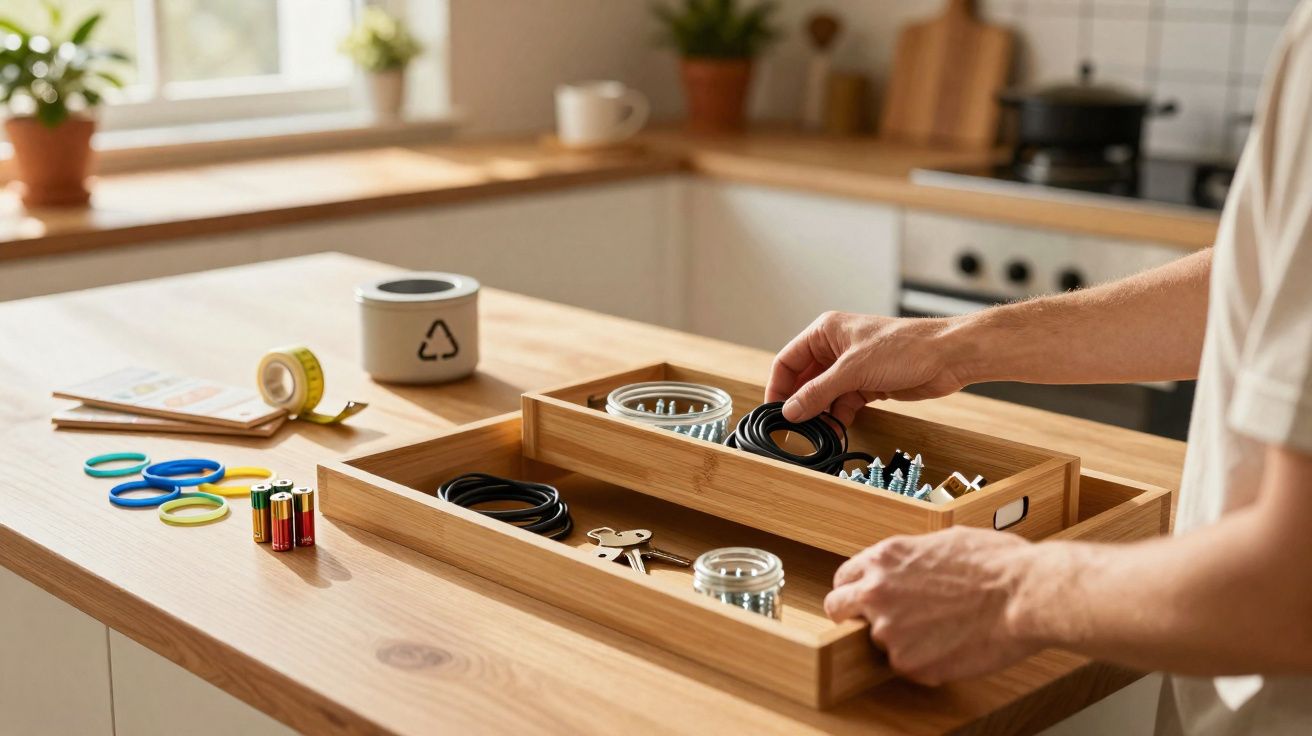
The handle is slim, the front panel gleams, and it lines up perfectly with the run of cupboards you were so pleased to pick in the showroom. Then you pull it out and the spell breaks instantly: loose batteries rattling against takeaway leaflets, dried-up biros knotted into bits of string, soy sauce sachets stuck to a half-warped tealight. Somewhere beneath the lot, there’s a spare key. Allegedly.
This drawer was meant to be “temporary” - a place to chuck things “for now”. Receipts, elastic bands, that tiny screwdriver you somehow need every time something goes wrong. Fast-forward a few years and it’s turned into a pocket-sized exhibition of domestic disorder.
This neglected drawer is often the messiest drawer in the kitchen.
And that isn’t by chance.
The quiet chaos living in your kitchen junk drawer
Open it and actually take stock - not as a job you have to do, but as a little snapshot of how you live. Loyalty cards for cafés you stopped going to ages ago. Scraps of the kids’ homework. A stray Allen key that probably came with a chair you no longer even own.
It’s the one spot in the kitchen where organisation gives up. Cutlery sits neatly in its tray. Spices get their rack. Pans pile into sensible stacks. But the kitchen junk drawer? That’s where everything without an obvious home gets shoved out of sight. No categories, no labels, no boundaries.
That’s why it can end up feeling more emotionally loaded than the magnets on your fridge door.
In one London flatshare, four adults shared a kitchen - and just one “anything drawer”. At the start it was harmless enough: spare keys and takeaway menus. Six months later it had swallowed a broken hairdryer, two phone chargers nobody claimed, eight soy sauce sachets, three opened packets of batteries, and the instruction manual for a washing machine they didn’t even own.
It became so crammed that opening it required bracing a hip against the cabinet and yanking as if you were trying to start a lawnmower. Items would pop upright and jam the runners. A pair of rusty scissors effectively acted as a bouncer, poking the underside of the worktop every time the drawer shifted.
One Sunday morning, someone went hunting for a single plaster. It took 12 minutes, a small argument, and the unearthing of a parking ticket from 2019. The plaster did eventually appear - naturally, underneath a knot of mystery cables.
The reason this drawer gets out of hand is, in fact, pretty rational. It’s the easiest option. It sits right where you stand to open the post, empty your pockets, or rip through parcels. Your brain likes the quickest route, so “drop it in the drawer” wins over “walk to the cupboard and sort it properly”.
Then there’s the guilt attached to objects. The battery that might still work. The key you’ll “definitely” need one day. The plumber’s business card that could come in handy. Throwing them away feels like tempting fate, so the drawer becomes a holding area for dozens of tiny decisions you’re not ready to make.
Over time, it stops being just clutter and starts becoming background mental static. You know the chaos is in there. You flinch slightly when a guest reaches for something and slides that drawer open. It’s like a quiet, persistent tab in your head: deal with me. Later.
How to reclaim the messiest drawer in the kitchen (without losing a weekend)
Drop the fantasy of “sorting the whole kitchen”. Do one small, stubborn thing instead: give this drawer 15 minutes. Not an afternoon. Not a Saturday. Just the length of time it takes to boil the kettle and make a proper cuppa.
Step one is non-negotiable: empty it completely onto the worktop. All of it. No “I’ll leave the big bits in”. Let the drawer sit there bare - slightly dramatic, slightly embarrassing, and very useful.
Next, grab three bags or containers and label them in your mind:
- Everyday
- Elsewhere
- Let it go
Everyday stays in the drawer. Elsewhere goes where it genuinely belongs. Let it go goes straight into the bin or recycling - no apologies.
Move quickly. Don’t debate every item like it’s a moral dilemma. If you stall for more than three seconds, it goes into Let it go. Your future self will thank you for that rule.
A lot of people “fix” a kitchen junk drawer by purchasing nicer-looking mess: shiny organisers, bamboo trays, acrylic boxes. They arrive looking like Instagram, then gradually fill with the exact same nonsense. The problem was never that it looked bad. The problem was that it wasn’t defined.
Think in categories, not containers. Decide what truly deserves a home here. For many households, a sensible list looks like this: working pens, a single notepad, one small toolkit, spare batteries kept in their original packaging, plasters, a lighter, and a roll of tape. Full stop. A strict list is what turns the drawer from a black hole into a useful station.
Let’s be honest: nobody does this perfectly every day. This isn’t about becoming the sort of person who alphabetises rubber bands. It’s about making one drawer dull and functional enough that it stops stealing your time and your patience.
“The junk drawer is where your delayed decisions go to sleep,” one professional organiser told me. “Change that one space, and you quietly change how you handle small choices everywhere else in the house.”
Once it’s empty, give the drawer one modest upgrade: a basic cutlery tray or adjustable dividers will do. Not for looks - as a built-in limit. When a section fills, it’s a prompt to edit, not to cram.
- Keep to one of each tool (one pair of scissors, one tape measure, one mini screwdriver).
- Contain the tiny stuff (batteries, paperclips, drawing pins) in a small tin or lidded pot so it can’t spread.
- Use a visible “expiry rule”: if you don’t use an item from this drawer for three months, it earns a one-way trip out.
The goal isn’t perfection. It’s a drawer you can open while guests are in the kitchen without feeling your shoulders tighten.
A quick safety and sustainability note for your kitchen junk drawer
While you’re resetting it, take 60 seconds to make it safer. Loose batteries can leak, and sharp tools can nick fingers when you rummage in a hurry. Keeping batteries together (ideally in their packaging) and putting blades or scissors in a fixed compartment makes the drawer calmer and less risky.
It’s also worth keeping a small “recycle later” envelope elsewhere (not in the drawer) for things like spent batteries, old cables, or dead pens. When there’s a clear place for items awaiting proper disposal, they’re less likely to boomerang back into the kitchen junk drawer.
What this little drawer quietly says about you
When the chaos clears, you start noticing the stories that were buried inside: faded leaflets for a gym you never joined, a warranty for an appliance you forgot you owned, spare buttons for clothes that left your life years ago.
In a way, the kitchen junk drawer is an archive of good intentions - diets you planned to start, hobbies you meant to try, repairs you swore you’d do “one day”. Clearing it isn’t only tidying; it’s choosing which versions of yourself you’re still carrying around.
Practically speaking, yes, you’ll locate your keys faster. But the bigger shift is learning to close out small decisions rather than leaving them to linger in the dark for months.
There’s also a quiet relief in having one place that behaves exactly as you meant it to. No mystery items. No mini-avalanches when you pull it open. You reach in for a pen and find… a pen. Not a dead torch, three dried-up highlighters, and a screwdriver from 2011.
On a dull Tuesday evening, when dinner’s running late and the bin bag splits, that tiny win counts more than you expect. You’re no longer battling the house as well as the day. One corner of your kitchen is helping you, not hindering you.
At a deeper level, taming the messiest drawer changes how the whole room feels. Suddenly, wiping crumbs doesn’t feel like bailing out a sinking boat. The “junk vortex” is gone, so the kitchen feels lighter, calmer, and more yours.
There’s something oddly intimate about that drawer, too. If someone you don’t know well opens it by mistake, it can feel exposing - not because of any single item, but because it’s clearly out of control.
Once you’ve reclaimed it, that moment changes. The drawer opens, everything sits where it should, and the story it tells is different. Not “perfect person with a label maker” - simply someone who’s decided that one small part of daily life doesn’t need to be a fight.
We all know the scene: you’re late for school or work, half-dressed, and you wrench the drawer open like it owes you money. Coins scatter, a rogue candle rolls to the back, and the batteries you bought last week have apparently vanished. It’s a tiny moment, but it can throw an entire morning off course.
Change that moment and you change the tone of your day. You gain a few extra breaths where there used to be swearing and frantic rummaging. You swap the low-level shame of “I really must sort this” for the quiet satisfaction of “it’s already done”.
The rest of the kitchen can remain a work in progress - the overflowing mug cupboard, the spices breeding behind the hob, the mystery Tupperware lids. That can all wait. You started with the place that used to swallow everything you didn’t know what to do with. And you gave it a purpose.
Maybe you’ll mention it to a friend later: “I finally sorted the junk drawer.” They’ll roll their eyes, laugh, and admit theirs is worse. And just like that, this hidden little space stops being a private embarrassment and becomes what it really is: a completely normal feature of modern life - and one that’s quietly ready for a reset.
| Key point | Detail | Why it matters to you |
|---|---|---|
| Identify the “junk drawer” | Treat it as a rule-free space where postponed decisions pile up | Understand why it becomes the most chaotic spot in the kitchen |
| Do a quick sort | Empty everything, then sort into three categories: “Everyday”, “Elsewhere”, “Let it go” | Take action without feeling overwhelmed or sacrificing an entire weekend |
| Build a simple system | Limit contents to a few clear categories, using basic dividers | Keep the drawer usable long-term and reduce everyday stress |
FAQ
How often should I declutter my kitchen junk drawer?
After a proper reset, a five-minute check every couple of months is usually enough. If opening it starts to feel like a gamble again, that’s your cue.What should never go in the kitchen junk drawer?
Anything sentimental, important documents, bank cards, or receipts you legally need to keep. Those deserve clearly labelled homes away from everyday chaos.Is it okay to have more than one “junk” drawer?
You can, but it usually doubles the confusion. One clearly defined mixed-use drawer with simple categories works far better than several small black holes around the house.How do I stop my family from messing it up again?
Walk them through the new layout, explain what belongs where, and keep it straightforward. When the drawer makes sense at a glance, people are much more likely to stick to it.What if I feel guilty throwing things away from the drawer?
Create a small “maybe box” stored outside the kitchen. If you don’t open it within three months, you can let it go with confidence - you didn’t truly need any of it.




Comments
No comments yet. Be the first to comment!
Leave a Comment