
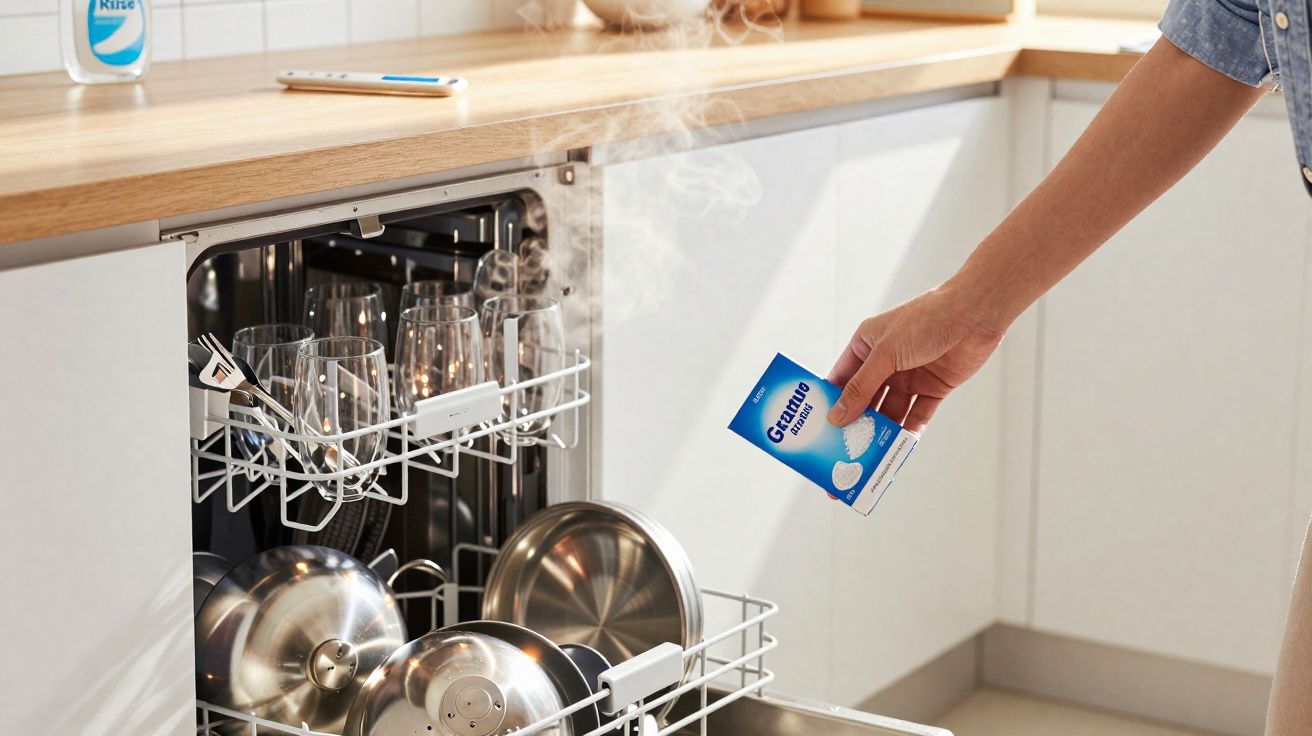
Sunday morning begins innocently enough: a coffee, unloading the dishwasher - and then the glasses catch the light like they’ve come straight out of an advert.
What’s behind it isn’t a new appliance or an expensive “miracle” tablet. In many homes, the biggest difference comes from a small change in how dishwasher salt is handled. Done properly, it often means less limescale, more shine and far fewer battles with cloudy glassware. It sounds trivial, but it comes down to physics, water hardness and a part of the machine that’s widely misunderstood.
Why dishwasher salt matters in the first place
For plenty of people, the salt reservoir only gets any attention during installation - or when the warning light starts flashing. Yet that compartment quietly supports one of the dishwasher’s most important jobs: coping with hard tap water.
Across much of the UK, mains water contains dissolved minerals that create limescale. Over time, that build-up clings to heating elements, internal pipework and, of course, your dishes. The usual symptoms are familiar:
- cloudy glasses
- dull cutlery
- white marks on plates and cookware
Dishwasher salt enables the ion exchanger to remove limescale-forming minerals from the water - which is what makes real shine possible.
Inside the appliance sits an ion exchanger (a resin-based softening unit). It captures calcium and magnesium ions - the “hard” part of hard water. To keep working, that resin has to be regenerated regularly using a concentrated salt solution. That is precisely what regeneration salt is for.
The single change that makes the difference: stop treating salt as an afterthought
A lot of disappointing results come down to the same three habits:
- topping up irregularly - or only once the warning light comes on
- pouring salt in quickly and immediately running a short cycle
- using the wrong salt (or relying entirely on multi-tabs)
The shift that many users report is simple: treat dishwasher salt as routine maintenance in its own right, not a quick job done in passing.
Step-by-step: a better way to use dishwasher salt (and why it works)
A more deliberate routine typically looks like this:
- Switch the dishwasher off and let it cool down.
- Open the salt reservoir and check the current level.
- Use dishwasher salt only - never table salt.
- Fill slowly until the reservoir is genuinely full; remove any spilled grains.
- Wipe around the opening with a cloth once finished.
- Then run a fairly long programme, ideally at a higher temperature.
The key change: don’t “top up quickly between cycles” - fill it properly and activate it with a full wash.
Handled this way, the salt solution is more likely to distribute correctly through the ion exchanger, any excess grains are flushed away, and the system can regenerate cleanly. The payoff often shows up fast - sometimes after one or two washes: less haze, fewer spots and noticeably clearer glass.
Water hardness settings: the crucial button most people never touch
Most dishwashers include a water hardness setting (in the menu or behind a small panel). That single setting determines how hard the ion exchanger works and how frequently it regenerates using salt.
Before changing anything else, it’s worth doing one thing first: find out your home’s water hardness. You can:
- check with your local water supplier, or
- use inexpensive test strips from supermarkets or DIY shops
Dishwasher salt only performs properly when the water hardness is set correctly - otherwise any “shine” is largely down to luck.
If your water is classed as hard or very hard, multi-tabs rarely replace the softening system fully. Many people discover their machine was left at a factory “medium” setting even though their tap water is much harder, which is a recipe for dull glassware and internal limescale.
Multi-tabs, rinse aid, salt: who does what?
“All-in-one”, “7-in-1” and similar multi-tabs are convenient, but they don’t always replace classic regeneration salt - especially in hard water areas.
| Component | What it does | Common mistake |
|---|---|---|
| Regeneration salt (dishwasher salt) | Softens water via the ion exchanger | Confused with table salt, or not used at all |
| Rinse aid | Helps water sheet off quickly so droplets don’t dry on surfaces | Overdosed, causing streaks or a bluish film |
| Cleaning tablet / multi-tab | Cleans dishes, breaks down grease and food residue | Expecting it to fully replace the water softener in hard water |
Manufacturers often note (usually in the small print) that in hard water areas the dishwasher still needs salt even when you use multi-tabs. Ignore that, and you often pay later with etched-looking glasses and scaled-up components.
What changes in day-to-day life after the switch
Glasses, cutlery, pans: the visible difference
When the salt reservoir is kept properly topped up, matched to the water hardness setting and followed by full-length programmes, people commonly notice:
- glassware looks clearer and more colour-neutral, without a grey veil
- cutlery shows more shine, especially on knife blades and fork tines
- stainless-steel pans develop fewer rainbow-like marks
- white plates come out without dull rims or powdery patches
A quieter side effect is that some machines smell fresher after several days, simply because less limescale and detergent residue collects in hoses, filters and spray arms.
Dishwasher lifespan and energy use
Limescale behaves like insulation on heating elements: the dishwasher needs more energy to heat the water to the same temperature. At the same time, seals and plastic parts can wear faster when hard deposits build up in awkward corners.
Consistent use of regeneration salt reduces stress on the whole system. Heating elements stay cleaner for longer, spray arms clog less often, and the interior is generally easier to maintain. That can also reduce reliance on harsh specialist cleaners, which may be tough on plastics and seals over time.
Common misunderstandings about dishwasher salt
“My tablets contain salt, so that’s enough”
The “salt” element in a tablet mainly influences the wash chemistry and helps manage minerals in the wash water. It does not regenerate the ion exchanger. The softener needs its own salt reservoir filled with proper regeneration salt to function.
“Salt in the reservoir makes dishes taste salty or causes marks”
Marks after topping up are usually spilled grains sitting on the rim of the tank or in the door seal. If you wipe the area after filling - or rinse away stray grains - those residue marks are far less likely.
When used correctly, salt doesn’t go directly onto your dishes; it stays within the closed loop of the ion exchanger system.
“Table salt is cheaper - it’ll do”
Table salt can contain anti-caking agents, iodine or fluoride. Those additives may harm the ion exchanger or leave residue. Dishwasher salt is typically coarse-grained sodium chloride designed to dissolve in a controlled way.
Limits and risks: when the “salt trick” won’t help (and when it can backfire)
Overfilling the reservoir or constantly topping up doesn’t automatically deliver more shine. Likewise, setting regeneration to an unnecessarily high level can leave the wash environment overly salty, which may put extra strain on components. The sensible approach is to follow the manual and avoid cranking settings up “just in case”.
In very soft water areas, extra salt offers little benefit. If settings are wrong, you can even end up with streaking because the water becomes too aggressive, especially on delicate glass.
Practical examples from everyday households
Scenario 1: A four-person household, hard water, a ten-year-old dishwasher. Glasses have looked milky for years and some are permanently etched. Rather than buying new glassware straight away, a one-month trial with corrected salt use can be worthwhile:
- test water hardness and set the dishwasher accordingly
- fill the salt reservoir fully and remove any spills
- run a dishwasher cleaner once
- then continue with tablets + salt, and slightly reduce rinse aid dosage
Permanently etched glasses won’t return to brand new, but new glassware usually stays clear for much longer. Many people also notice fewer limescale marks on stainless-steel sinks and cutlery.
Scenario 2: A home with medium water hardness. The improvement came from using multi-tabs only for heavily soiled loads and switching otherwise to separate dosing (powder, rinse aid and regeneration salt). That extra control over each component often produces visibly better results.
Quick definitions that often cause confusion
- Regeneration: the ion exchanger releases trapped calcium/magnesium into a strong salt solution, “resetting” the resin so it can soften new incoming water.
- Ion exchanger resin: the small plastic beads inside the softening unit that bind specific ions, mainly calcium and magnesium.
- Water hardness: a measure of those minerals in water; the higher it is, the more readily limescale forms - in kettles, on shower screens and inside dishwashers.
Combining dishwasher salt with other changes for even better results
Once the salt reservoir is being used properly, a few other adjustments can help:
- Reduce rinse aid slightly if you’re seeing shimmering films on glass.
- Favour standard or longer programmes over short cycles so detergent and regeneration processes can complete properly.
- Clean the filter and spray arms regularly, because even softened water can’t compensate for restricted water flow.
One extra point that’s easy to miss: not all “cloudiness” is limescale. If the haze doesn’t shift at all and feels etched rather than powdery, it may be permanent glass corrosion from years of harsh wash conditions. Correct salt use won’t reverse that damage - but it can stop new items from deteriorating as quickly.
Used together, these small changes can make the dishwasher feel noticeably “younger” and the tableware look newer - not through anything magical, but because the machine is finally working with water conditions set the way the manufacturer intended.





Comments
No comments yet. Be the first to comment!
Leave a Comment