
The first properly warm day of spring arrives and you lift the lid on your compost bin, fully expecting that rich, woodland scent everyone online bangs on about.
Instead, you’re met with a wall of pong that’s somewhere between rotten eggs, a forgotten sandwich box and a damp dog. You drop the lid in a hurry, eye the neighbour’s garden like it might be to blame, and quietly swear you’re “never composting again”.
Five minutes later, you’re still on Google in a small panic, typing: “Is compost meant to smell like something died?”
No.
And the more useful truth is that you can usually put it right far quicker than you’d expect.
Why your compost smells like a rubbish lorry in July
A stinky compost pile nearly always means the mix is out of balance. It’s not “ruined”; it’s simply gone off-key.
What your nose is picking up is food waste breaking down without enough air, or without the right “recipe” around it. In other words, you’ve accidentally created a slow-motion gym-locker situation at the bottom of your garden.
When compost turns sour, it’s almost always signalling one (or more) of the following:
- It’s too wet
- It’s too compacted
- It’s loaded with greens (kitchen scraps, grass clippings) but short on browns (dry leaves, shredded cardboard, straw)
Once you work out which problem you’ve got, the solution becomes oddly straightforward.
Imagine a small city garden, one plastic tumbler, and a very keen beginner. They watch a handful of TikToks about composting, then chuck in coffee grounds, fruit peel, leftover salad, and that half bag of spinach nobody ever eats in time.
Two weeks later, every lid-lift releases a cloud so strong the dog won’t go near it. A neighbour mentions, with impressive restraint, that “something smells like it’s rotting” by the fence.
What actually happened? A dense, wet, oxygen-starved lasagne of kitchen waste: no airflow, no structure, and no carbon-rich browns to calm down the nitrogen-heavy greens.
Aerobic vs anaerobic: the science behind the stink in your compost bin
Compost smell is chemistry you can detect instantly. When there’s plenty of oxygen, aerobic bacteria dominate-these are the helpful workers that produce that clean, earthy “forest floor” smell.
When the pile becomes soggy or tightly packed, oxygen drops and anaerobic bacteria take over. That’s when you get the foul stuff: sewage, vomit, rotten eggs. The gases involved (methane, ammonia, hydrogen sulphide) aren’t just unpleasant-they’re your compost’s warning light flashing.
The other big issue is balance. Too many greens without enough browns encourages rotting rather than composting. The upside is that the right dry material, added in the right way, can shift things dramatically in minutes.
Quick fixes for a smelly compost bin: clear the stink fast
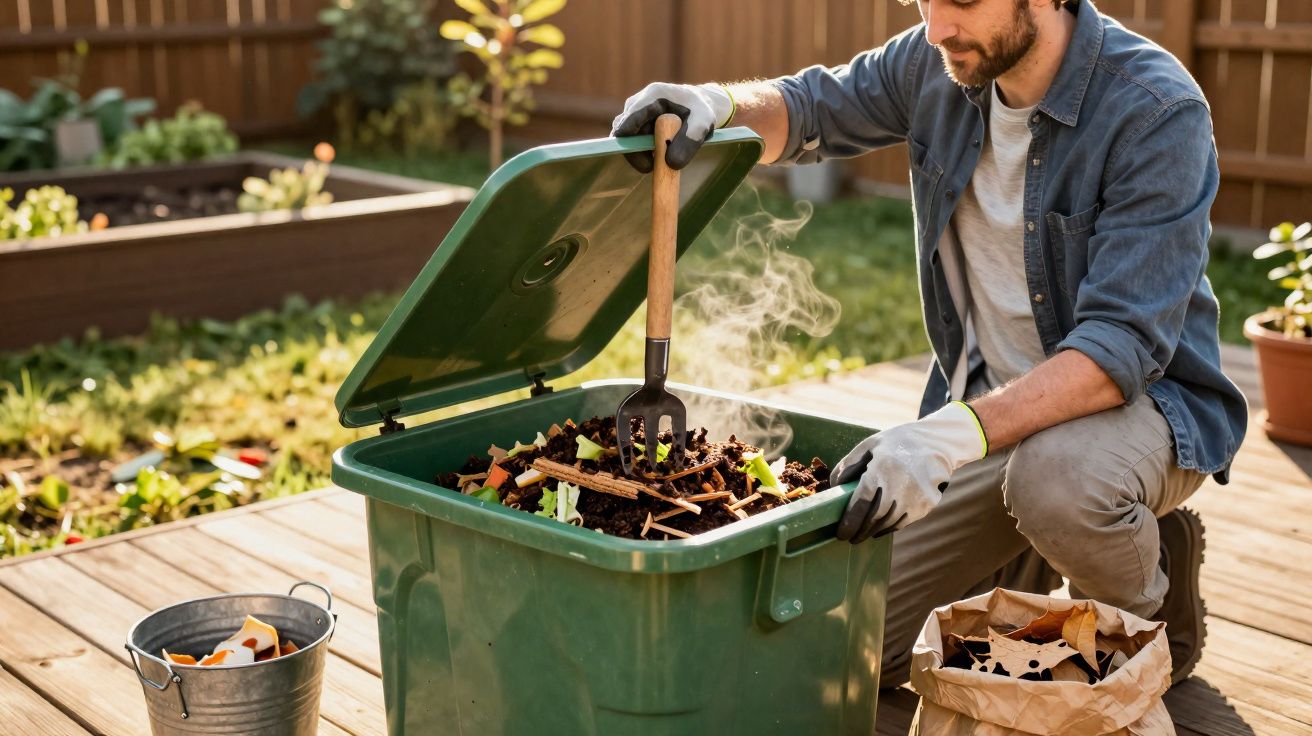
If you open the lid and the odour hits you, start with the simplest move: add air. Push a garden fork into the centre and lift/loosen the contents as if you’re tossing a gigantic salad.
- Drag the wet, heavy material from the middle out towards the edges
- Break up any slimy clumps of grass or food scraps
- As you turn, mix in dry material (shredded cardboard, dead leaves, wood shavings, even torn-up paper bags)
That one action can make a noticeable difference quickly because you’re letting the pile breathe again. Oxygen is the fastest natural deodoriser you’ve got.
The second rescue move is adding structure and dryness. Think of browns like kitchen roll on a greasy tray: they absorb excess moisture and create tiny air pockets throughout the heap.
If your compost looks shiny, slippery, or like a green smoothie that’s gone wrong, you likely need more browns than you think. Add a thick layer, mix it through lightly, then finish with another dry layer over the top like a blanket.
And yes-real life gets in the way. You won’t balance every addition perfectly. You’ll tip in a week’s worth of kitchen scraps in one go. That’s normal. The practical trick is to keep a sack of leaves or a box of shredded cardboard right next to the bin, and throw a handful on top every time you add greens. It’s lazy, consistent odour control.
When the smell won’t shift, it helps to borrow wisdom from people who have made every composting mistake already:
“Compost only stinks when we treat it like a bin for rubbish instead of something living,” said a community garden volunteer I met on a city plot that stayed sweet-smelling all season. “Whenever someone added food waste, they followed it with a handful of leaves. It became automatic-like washing your hands.”
If you want a quick mental checklist, use these three actions:
- Add air: turn the pile or poke holes through it.
- Add browns: leaves, paper, straw to soak up slime and improve airflow.
- Adjust size: chop big items, and avoid leaving giant wet clumps intact.
Once you start treating compost as something you feed and oxygenate, rather than a dumping ground, the smell often fades on its own.
Two extra checks that prevent smells returning
A couple of practical details can stop you ending up back at square one:
First, check drainage and weather exposure. If rain can get into an open heap or an unprotected bin, it can turn your mix waterlogged very quickly. A lid that fits properly-or a simple cover-can make a surprising difference, especially in a wet spell.
Second, think about where the bin sits. If it’s on hard paving with nowhere for excess liquid to go, it’s easier for the bottom to become anaerobic. Placing the compost bin on bare soil (where possible) helps with drainage and allows beneficial organisms to move in.
From embarrassment to bragging rights
There’s a particular kind of quiet embarrassment that comes with a rancid compost bin. You start wondering whether the neighbours can smell it. You lift the lid less and less, hoping it will somehow sort itself out.
The irony is that a bad-smelling pile often means you were genuinely trying. You bothered to save scraps, set up a system, and start. The stink is just the awkward teenage stage of your compost’s life.
Once you understand the basics-air, moisture, and a good balance of greens and browns-it stops feeling like a grim experiment and starts becoming oddly satisfying. People ask how you got your soil so dark. You catch yourself prodding the heap just to check how warm and crumbly it’s getting.
Talk to enough gardeners and you’ll hear the same pattern: almost everyone has had a smelly pile at some point. The split between those who give up and those who swear by compost usually comes down to one decision-the day they stop seeing it as a failure and start treating it like a puzzle.
You begin to notice repeat offenders. Grass clippings on their own? Slime and stink. Coffee grounds without paper or leaves? Dense and sour. But when you layer, mix, and keep oxygen moving through, your nose is the first thing that tells you you’re back on track.
Some people take it further than you’d expect. They turn the pile after heavy rain, collect cardboard like it’s valuable, and sniff the compost like a barista checking coffee beans. It sounds daft until you wheel out your first barrow of dark, sweet-smelling compost and realise you made it from what used to be “waste”.
The straightforward truth is this: smelly compost isn’t a failure-it’s feedback.
Once you learn to read that feedback, compost becomes something that fits around your life instead of demanding perfection. Busy week? Cover scraps with extra browns and turn it when you can. Small balcony bin? Chop pieces smaller and keep the mix lighter and drier.
You don’t need qualifications, a flawless system, or expensive kit. A fork, some dry browns, and a willingness to get your hands a bit mucky will do. From there, the smell-or the lack of it-becomes your best teacher, and that’s the moment your compost quietly shifts from a source of embarrassment to something you’re unexpectedly proud to show off.
| Key point | Detail | Value for the reader |
|---|---|---|
| Bad smells mean imbalance | Odours usually come from too much moisture, too many greens, and not enough air | Helps you pinpoint the issue quickly instead of giving up on your bin |
| Fast fix: air + browns | Turn the pile and add dry, carbon-rich materials like leaves or cardboard | Gives you a simple, repeatable way to clear smells in minutes |
| Smell as your guide | Earthy smell = on track; rotten or sour = adjust air, moisture, and mix | Lets you manage compost by feel, without complicated rules or tools |
FAQ
Why does my compost smell like rotten eggs?
That sulphur smell normally means the pile has gone anaerobic: too wet, too compacted, and short on air. Turn it thoroughly and mix in plenty of dry browns such as shredded paper, straw, or leaves.Can I still use compost that smelled bad?
Yes-provided you let it finish decomposing and the odour disappears. When it’s back to smelling earthy and looks crumbly, it’s fine to use in the garden.How wet should my compost be to avoid smells?
Aim for “wrung-out sponge” damp. If you squeeze a handful and water drips out, it’s too wet: add browns and turn. If it feels dusty and won’t hold together at all, add a little water or more fresh scraps.Are there foods that always cause bad smells?
Big piles of grass clippings, lots of citrus, and oily or fatty foods can start to pong quickly. Meat and dairy are the worst offenders outdoors, and many home composters avoid them altogether.How often should I turn my compost to keep it from smelling?
For most home compost piles, turning every 1–2 weeks is plenty. Very small, active piles may benefit from a quick fluff more often, particularly after heavy rain or a big dump of kitchen scraps.


Comments
No comments yet. Be the first to comment!
Leave a Comment