
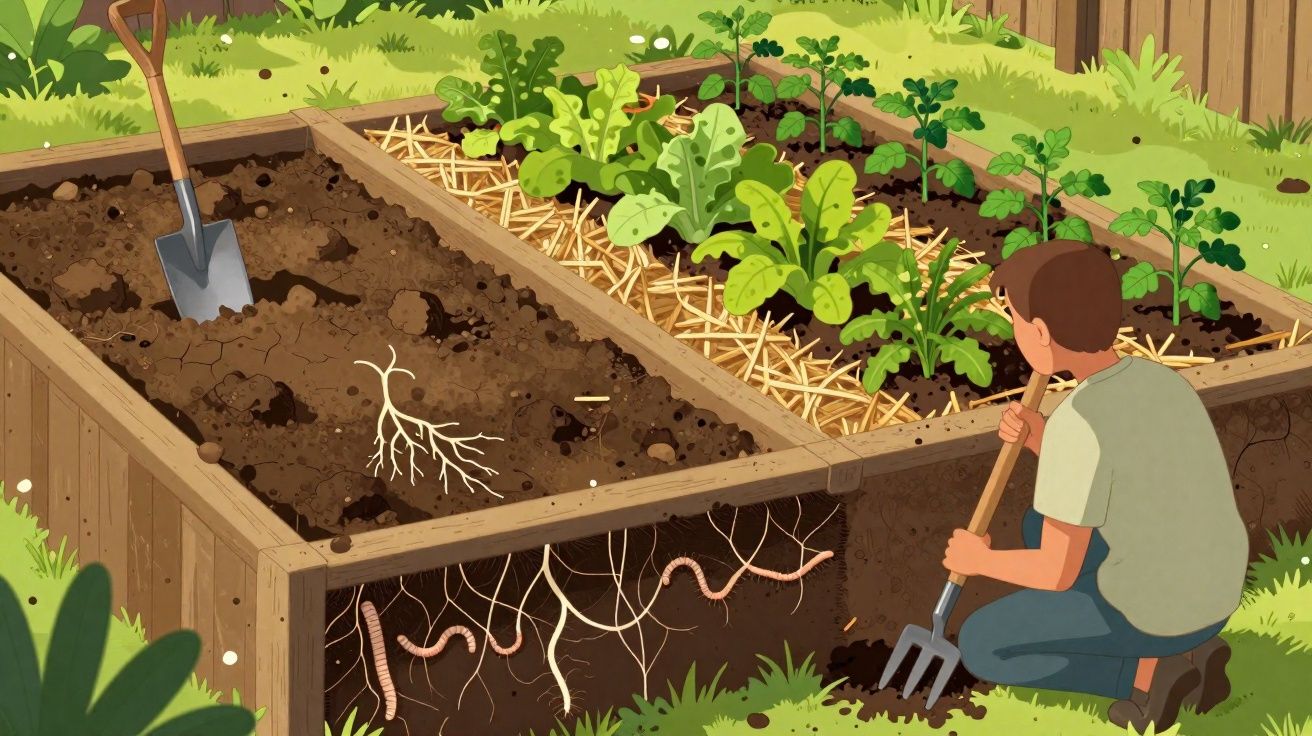
In many people’s minds, a “proper” vegetable garden means a neatly turned, brown plot of completely bare soil. If you do not dig your bed over until you are sweating, you are often assumed to be lazy. Yet this very ritual - deep digging, breaking the soil apart and levelling it flat - is increasingly being recognised as one of the most damaging habits in the home garden.
Why the image of the “tidy” bed is so persistent
For generations, people have been taught the same lesson: if you want a good vegetable garden, you have to work hard. A sore back is almost treated as a badge of honour. Many gardeners reach for the spade as soon as the ground thaws in spring, convinced that the soil needs them so it can “breathe”.
At its core, this idea comes from industrial agriculture. There, machines plough vast monoculture fields to prepare seedbeds and control weeds. Those methods were then copied uncritically into the home garden, even though the conditions are fundamentally different: a few square metres rather than hectares, mixed planting rather than monoculture, and hand tools rather than tractors.
The ideal of the “well-kept” garden also plays a part. A bare, crumbly surface with not a blade of grass in sight looks tidy, controlled and almost sterile. In nature, by contrast, completely bare soil is usually a warning sign - for example after landslips, flooding or wildfires. Living soil is almost always covered: by plants, leaves, dead plant matter and roots.
What looks “clean” to the eye is often an ecological emergency for the soil.
Leaving the soil covered is not untidy; it is protective. A permanent blanket of organic material cushions heavy rain, slows moisture loss and feeds soil life, all while reducing the need for constant intervention.
What happens below the surface when you dig
When you dig, all you may see at first is soil. Beneath your feet, however, lies a highly complex ecosystem of animals, fungi and bacteria working together like a living organism. Every deep spade cut hits it like an earthquake.
Earthworms as displaced underground workers
Earthworms create channels, loosen the soil, mix in organic matter and ensure excellent natural drainage. Certain species bore vertical shafts downwards, allowing air and water to move ideally into deeper layers.
When you dig, you destroy those channels, bring the animals to the surface and expose them to light and predators. Many die, and the population collapses. The result is less natural drainage, more waterlogging and greater compaction.
The invisible fungal network is cut apart
Another victim that is often overlooked is the fungal web, known as mycelium. The finest fungal threads connect plant roots to one another and act as a transport system for nutrients, water and chemical signals.
Every spade cut slices through this network. Plants then have to rebuild connections slowly, rather than using their energy for flowers, fruit and roots. In the long term, that weakens the entire system, even if the damage is not immediately visible at the surface.
How digging can paradoxically make soil as hard as concrete
Many gardeners know the pattern: after digging, the soil looks loose and crumbly, almost like fine semolina. After a few heavy spring showers, a hard grey crust forms and even a hoe can barely get through it. Experts call this surface sealing or crusting.
The reason is simple: healthy soil is made up of stable crumbs, known as aggregates. They are held together by clay, humus and the “glues” produced by soil organisms. These crumbs create air spaces and places where water can be stored.
If you break the soil down too aggressively, you reduce those crumbs to dust. Rain washes the fine particles into the pores, everything sticks together, and when it dries a hard cap forms. Rainwater then runs off instead of soaking in. Roots struggle through a layer that is almost cement-like.
The more often you “loosen” the soil by digging, the more vulnerable it becomes later to compaction and waterlogging.
Digging literally brings weeds to the surface
Weeds can feel like a curse. Many people spend their weekends bent over beds pulling them out by hand. What is interesting, though, is that deep cultivation acts as a turbo boost for exactly these plants.
Hidden below ground is an enormous seed bank: millions of tiny seeds from thistles, bindweed, chickweed and others that can lie dormant for years. As long as they stay in the dark, very little happens.
Dig them up and those seeds are brought to the surface. Light, oxygen and temperature changes become their starting signal. They germinate in masses while the vegetable crop is still delicate and barely under way. If you leave the soil undisturbed and cover it instead, you prevent this germination trigger.
- Heavy digging = many fresh weed seeds brought to the surface
- Undisturbed, covered soil = seeds stay deep and inactive
- Result: the more you dig, the more you have to weed
When soil becomes addicted to nutrients
A common argument in favour of digging is: “It gets the nutrients moving.” That is true - but only briefly, and at a later cost. Bringing in lots of air sharply increases the activity of certain bacteria. They then break down organic matter at a very fast rate.
This gives you a quick fertiliser hit: nitrogen, phosphorus and other nutrients are suddenly released. Plants grow vigorously and everything looks like success. At the same time, though, you burn through your humus reserves. The soil’s storage material disappears like wood in a stove that is being fired too hot.
Once humus has been heavily depleted, the soil holds water and nutrients less and less effectively. Watering makes little difference, and fertiliser has to be applied again and again. The garden becomes dependent: without regular outside input, nothing much happens.
Instead of becoming fertile for the long term, a bed that is dug too often can slide into fertiliser dependence.
Gentle alternatives: loosening soil without turning it over
The good news is that if you are planning your planting, you do not need to give up - you just need a different approach. The aim is to aerate the soil without mixing up its layers or destroying the organisms living in it.
Broadforks and similar tools that loosen only
Instead of a conventional spade, use a digging fork or a broadfork. It is placed upright in the soil and then gently tipped back. The earth opens up at depth, but mostly stays where it is. No flipping, no churning.
That creates more air in the soil, roots can penetrate more easily, and rainwater drains faster - while earthworm channels and fungal networks remain largely intact.
Plants and mulch as natural soil workers
An even better method is to let nature do the work. Rather than leaving beds bare over winter, it is worth keeping them covered:
- leaves, straw or grass clippings as a mulch layer
- wood chips or coarse plant cuttings
- unbleached cardboard underneath to suppress weeds, with organic material on top
Earthworms pull this material down, mix it in, and their burrows loosen the soil more effectively than any machine. At the same time, the surface is protected from driving rain, so crusting almost disappears.
Another option is green manure plants such as phacelia, mustard or rye. Their roots break up compacted layers, thread through the soil and, once they die back, leave behind a fine network of channels - along with an in-built supply of nutrients.
A further advantage of keeping the ground covered is that it creates a steadier habitat for beneficial insects and soil organisms. That means fewer temperature swings, less drying out in hot spells and better protection against nutrient loss during wet weather.
How a “lazy” gardener can harvest more in the long run
If you leave the spade in the shed, neighbours may initially think you are being easy-going. In reality, the work simply changes shape: less digging, more observing and planning. Many people who switch to no-dig or soil-friendly growing report clear results after one or two years:
- The soil can be loosened by hand, even after wet periods.
- Weed pressure falls because fewer seeds reach the surface.
- Plants appear stronger, more disease-resistant and need watering less often.
- Your back benefits because the hardest digging jobs disappear.
A little patience is important. A depleted bed that has been dug repeatedly needs time to rebuild its structure and life. If you mulch consistently for a year or two, use green manure and loosen the soil only gently, you will notice that the earth gradually starts to “breathe” again.
Helpful terms explained briefly
Humus: Dark, stable organic matter in the soil. It stores water and nutrients like a sponge and is crucial for structure and fertility.
Mycelium: The fine thread-like network of fungi in the soil. It connects roots, transports nutrients and enables a kind of communication between plants.
Green manure: Special plants that are not grown for harvest, but only to improve the soil. After they die back, they remain in the bed as a source of nutrients and structure.
Practical example for starting a soil-friendly garden
If you want to change your habits, begin with one test bed. A simple approach looks like this:
- Remove only coarse weeds from the surface; do not dig deeply.
- Loosen the soil in places with a digging fork, without turning it over.
- Spread a 5–10 cm layer of compost or well-rotted manure.
- Add mulch material on top, such as leaves, straw or grass clippings.
- Plant into small holes, moving the mulch slightly aside as needed.
Even in the first summer, you will usually notice less watering, far fewer weeds and a noticeably looser soil structure. If you keep this up for a few years, you may wonder why you ever spent hours battling the spade in the first place.
Conclusion: work with the soil, not against it
In the end, it comes down to a simple question: do you want to work against your soil, or with it? If you change course and choose gentle methods, you often harvest more, with less stress and with a much healthier garden ecosystem.


Comments
No comments yet. Be the first to comment!
Leave a Comment