
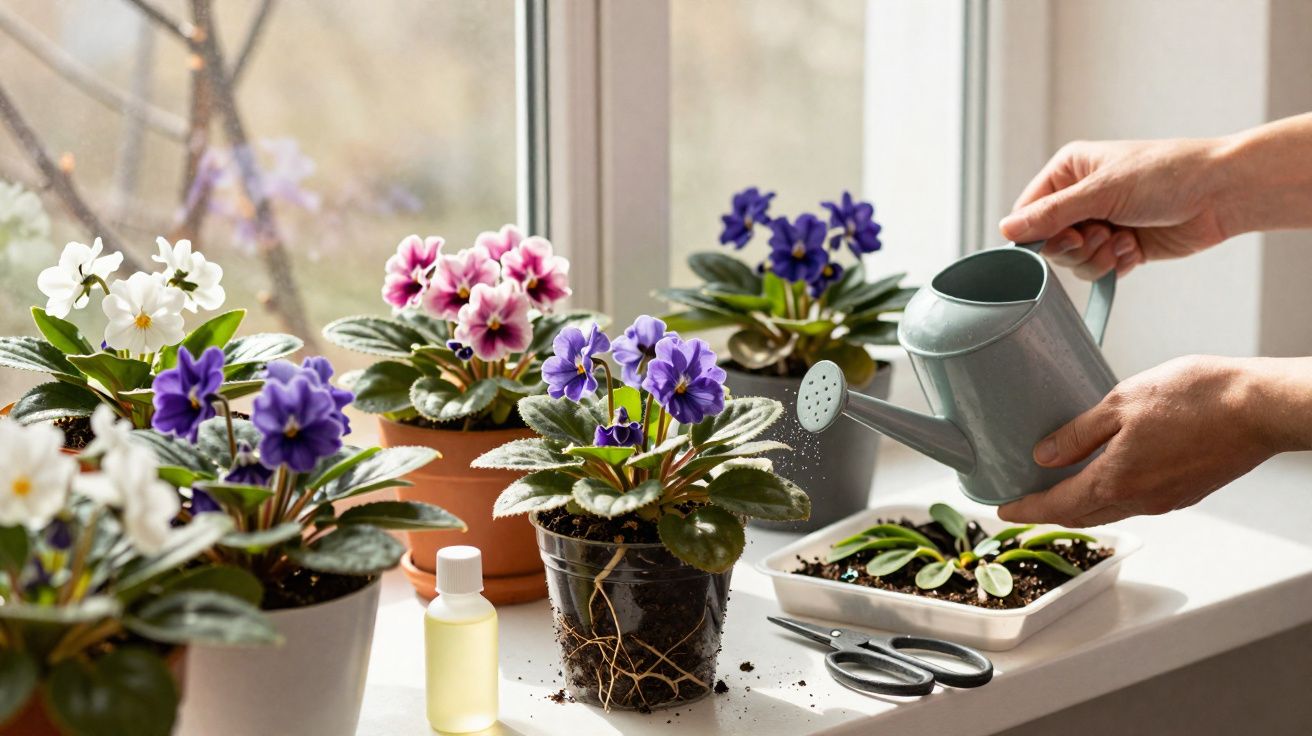
Many African violets look tired after winter: limp growth, dull leaves, and hardly any buds. March is exactly when they enter a fresh phase. If you introduce a few subtle but highly targeted routines now, you can be rewarded with almost uninterrupted flowers right through to summer - even on the windowsill of a city flat.
Why March is so important for African violets
African violets are among those houseplants that can, in theory, flower almost all year round. In practice, that only happens when light, water, nutrients, and pot size are roughly right. After the dark winter months, the plant begins its growth phase in March. At this point it shifts gears: more light, more energy, more leaf mass, and new buds.
If you deliberately “wake up” your African violets in March, you set the tone for how freely they will flower from spring into summer.
This transitional period makes the plants especially sensitive: too much sun scorches the leaves, while too little light slows bud formation. Water and fertiliser are equally delicate matters. A clear care routine helps you avoid mistakes.
The ideal position: plenty of light, but no harsh sun
In March, the days are brighter, but the sun still sits relatively low in the sky. For an African violet, that is both a blessing and a challenge. It needs more light now, but it must not get sunburnt.
African violet light conditions on the windowsill
An ideal spot is:
- on an east- or north-facing window with lots of brightness but no fierce midday sun
- or about 30 centimetres back from a west- or south-east-facing window with a thin curtain
- with the pot turned regularly so the leaf rosette grows evenly
The signs of poor light are usually very clear:
- leaves stretch noticeably towards the window: not enough light
- leaves become very pale, yellow, or brown and scorched: too much direct sun
- few or no buds: usually a lack of light or a site that is too cool
If all you have are dim rooms, you can use a grow light. A simple LED panel above the windowsill, run for 10–12 hours a day, is enough for many amateur gardeners.
Temperature - not too warm, not too cold
African violets are happiest at room temperature, provided there are no extreme swings. The guide values are:
- around 18 to 24 degrees during the day
- 4 to 5 degrees cooler at night
- not permanently below 16 degrees, although slightly cooler conditions may be possible for a short time after repotting
If the pot sits directly above a radiator, the air becomes far too dry. The plant dislikes that. A slightly offset position is better, or place a small tray of water and stones nearby to raise humidity a little.
A useful extra habit in March is to check for draughts. Cold air from a cracked window or a frequently opened door can stall growth just as much as poor light, even when the plant otherwise looks healthy.
Watering correctly in March: moist, but never sodden
In winter, many growers get by with very sparing watering. In March, the need for water rises - but waterlogging remains the greatest enemy.
The compost should feel lightly moist, not swampy. It is better to water once too little than once too much.
Practical watering tips
A healthy watering routine can be built like this:
- check the top 1–2 centimetres of compost with your finger: water only when they are dry
- always use room-temperature to lukewarm water, never cold water straight from the tap
- do not let water run over the leaves or into the crown of the rosette
Many experienced plant lovers prefer to water from below or by standing the pot in water:
- place the pot in a bowl of water for 15–20 minutes
- let the compost soak it up
- allow the pot to drain well before it goes back on the windowsill
If water sits in the saucer for too long, the roots quickly rot. A slight droop in the leaves usually recovers quickly if the plant is watered in time - but if the compost stays wet for too long, the whole plant can collapse.
Feeding: a gentle start to the season
In autumn and winter, African violets should receive little or no fertiliser. That changes in March. New leaves and buds use up nutrients, and the supply in the potting compost is often exhausted.
Suitable options include:
- liquid balanced fertilisers, such as 20-20-20
- specialist African violet fertilisers, for example blends such as 14-12-14
Dose is crucial: use a weak mix, but apply it regularly. Two options are:
- every 2–4 weeks in a low concentration through the watering water
- or about once a month at normal dilution
Too much fertiliser leads to rampant leaf growth, burnt roots, and, paradoxically, fewer flowers. If you are unsure, simply halve the manufacturer’s recommendation and watch how the plant responds.
Repotting, tidying, and rejuvenating - a spring clean for the pot
March is a good time to take a careful look at both the plant and its container. African violets prefer small, shallow pots and actually like being slightly snug. Even so, the plant needs fresh compost every few years.
When a new pot makes sense
An interval of 1–3 years has proved effective. Signs that repotting is due include:
- roots are visible coming out of the bottom of the pot
- the compost seems heavily compacted and dries unevenly
- despite good care, flowering is clearly weaker than expected
For repotting, a pot only marginally larger is usually enough, provided it has drainage holes. Put a layer of expanded clay or gravel in the bottom, then add a loose, free-draining growing medium - ideally with a little perlite for improved aeration.
Cleaning and thinning the leaves
During the spring clean, remove everything that is draining energy from the plant unnecessarily:
- yellow, soft, or badly damaged leaves
- old flower stalks and dried flower remnants
- obviously dusty leaves
Weak leaves can often simply be pulled away; otherwise, cut them cleanly at the base with a sterile pair of scissors. Never remove more than about one-third of the foliage at once, or the plant will become too stressed.
Dust can be removed from the velvety leaves with a soft brush or a gentle blower used for camera equipment. That lets more light reach the surface again, improves photosynthesis, and makes the plant look fresher straight away.
Now is the time to produce new plants: leaf cuttings in spring
Anyone who wants to propagate a favourite African violet has ideal conditions in March. The plant is in growth, the days are longer, and the air is no longer as cold and dry as it was in winter.
From a single healthy leaf in spring, you can often raise several young plants - almost free of charge.
Here is a simple leaf cutting method:
- choose a strong, healthy leaf
- cut it off with a clean knife or scissors, leaving a 3–5 centimetre stalk
- decide whether to insert it into slightly moist, loose compost (for example, peat with perlite) or stand it in a glass of water
- place it somewhere bright, but not in direct sun
After about 6–8 weeks, the first tiny plantlets usually appear along the leaf stalk. If you use water, roots should form first before the cutting is moved into compost. If you take several leaves, you have a good chance of building up a whole little shelf of new varieties or giving plants away to friends.
Common mistakes and how to avoid them in March
The same problems tend to recur at this time of year. A quick overview makes diagnosis easier:
| Symptom | Likely cause | What to do |
|---|---|---|
| Leaves are soft and droop badly | Too much or too little water | Check the compost, adjust the watering rhythm, pour off any standing water |
| Hardly any flowers, lots of leaf growth | Too much fertiliser or too little light | Reduce feeding, move the plant to a brighter spot |
| Scorched, pale patches | Sunburn or cold water on the leaves | Shift the plant slightly and water only with lukewarm water from below |
| Sticky patches, fine webbing | Pests such as spider mites | Inspect the plant, isolate it if necessary, and treat it |
Why the March routine pays off over time
African violets are often dismissed as “granny plants”, but they are in fact extremely rewarding long-term bloomers once they are settled in properly. If you create a fixed March routine every year - checking the position, repotting carefully, watering in a measured way, applying the first feed, and giving a light tidy-up - you build a little flowering engine on the windowsill.
With good care, the plants can easily live for ten years or more. Many collectors keep whole rows of different varieties - from deep violet to pure white, from single flowers to double ones - and treat March almost like an annual inspection for their collection. In flats without a balcony, that creates a small, low-maintenance strip of colour that keeps going from spring well into summer.
If you have never approached March care quite so deliberately, start with just one specimen and note what changes: flowering time, number of blooms, and growth habit. After just one season, it becomes clear how much difference a seemingly modest care routine can make in the first month of spring.





Comments
No comments yet. Be the first to comment!
Leave a Comment