
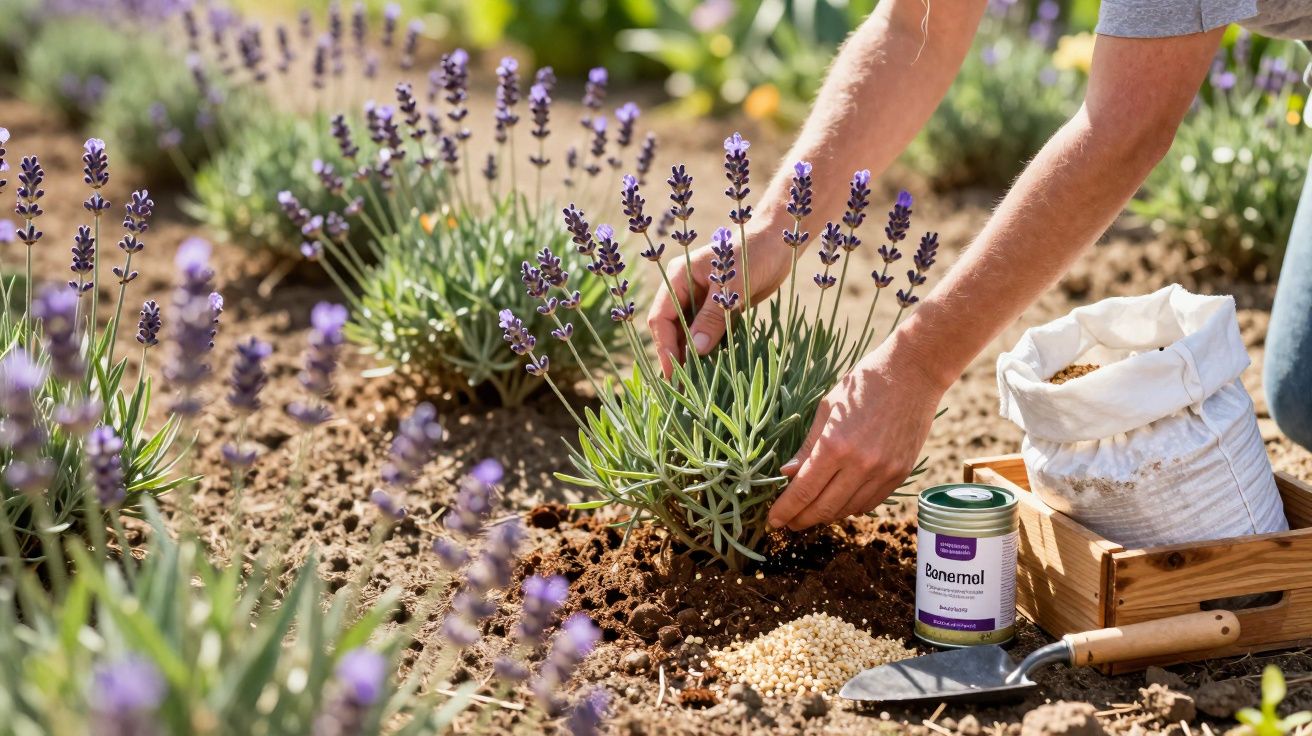
Many home gardeners know the feeling: the sun is out, the plant is watered, and yet the lavender only produces a handful of sparse flowers. The problem often does not lie in summer at all, but in the soil months earlier. If you give your plants the right natural nutrients in spring, you are usually rewarded in midsummer with a far fuller, stronger display of flowers.
Why lavender needs only a little, but very targeted, care in spring
Lavender originates from the poor soils of the Mediterranean region. There it grows in stony, dry, fairly chalky ground. That is exactly why it gets by with comparatively few nutrients and can suffer badly if it is treated like a hungry border perennial.
In soil that is too rich, this happens: the plant produces lots of leafy growth, the stems become soft, and the flower spikes stay short and thin. The shrub may still look green, but the classic lavender picture in purple never really appears.
Lavender thrives in lean, well-drained soil, plenty of sun, and just a light, well-planned nutrient boost in spring.
That is where a natural feeding trick comes in, used only once a year. The aim is not the maximum possible amount of fertiliser, but a well-balanced combination of organic matter, minerals and lime.
The secret trio for lavender: compost, bone meal and garden lime
Many experienced gardeners rely on a simple but highly effective mix made from three everyday garden ingredients:
- Well-rotted compost – improves soil structure and provides nutrients gently
- Bone meal – supplies phosphorus and calcium for roots and flowers
- Garden lime – raises the pH and creates the chalky conditions lavender prefers
The mixture is prepared in equal parts, using a 1:1:1 ratio. A small bucket is enough for several plants. Well-rotted compost loosens the soil, holds a little moisture without making it soggy, and feeds the soil life. Bone meal works more slowly, but for longer, and supports the formation of strong roots and plenty of flower buds. Garden lime helps ensure the soil is not too acidic, which is a common reason lavender struggles in some gardens.
How to apply the mixture correctly
The method is straightforward; the timing is what matters most:
- In March or April, clear a loose ring of soil around each lavender plant.
- Mix the feeding ingredients in a small bucket in equal parts.
- Depending on the size of the plant, scatter one or two small handfuls around the root zone.
- Work it in very lightly with a hand fork or small claw, only into the top few centimetres.
- Water sparingly afterwards so the nutrients are washed down to the roots.
Important: the mixture should not go directly against the base of the stems, but should be placed in a loose ring around the plant. That way the nutrients reach the area where most of the fine roots are, while the crown remains airy and dry.
The ideal timing: spring determines the July display
The best period for this care lies between early March and late April, once the hard frosts are over but before lavender has properly entered its growth and flowering phase. During this window, the plant can store the nutrients calmly and set up strong flowering shoots.
In milder regions, the date may be early; in higher-altitude areas, it may be later in April. What matters is that the soil is no longer frozen, but the flower spikes have not yet pushed on strongly.
| Location | Recommended feeding time | Amount per plant |
|---|---|---|
| Border, young lavender | Mid-March to early April | about 1 small handful |
| Border, older, larger lavender | Mid-March to late April | 2 small handfuls |
| Potted lavender | Mid-April, frost-free | ½ to 1 small handful |
Lavender spring care: the mistakes that hold back flowering
If you treat lavender like roses or tomatoes, you will often slow it down without meaning to. The most problematic mistakes are:
- Strong, nitrogen-heavy all-purpose fertilisers – they encourage soft leaf growth instead of sturdy flower stems
- Fresh farmyard manure – heats the soil too much and delivers too many nutrients at once
- Thick layers of bark mulch – hold on to moisture for too long and can cause plants to rot
- Frequent feeding throughout the season – makes the plant more vulnerable and strips away its toughness
If you feed once in spring in a moderate way and then consistently avoid any further nutrient applications, you will usually get far better results. In summer, care then comes down to restrained watering and a fully sunny position.
One well-planned feed in spring does far more than lots of small “treats” spread across the year.
Site, pruning and watering: what lavender still needs
Fertiliser on its own does not create a sea of flowers. Three other factors decide whether the plant shows its full potential in July:
1. Sun, sun and more sun
Lavender belongs in the brightest spot in the garden. At least six hours of direct sun per day is ideal. In partial shade, the plant will still produce foliage, but the flowers will fall well short of expectations.
2. Free-draining soil rather than waterlogging
Heavy clay soils should definitely be improved with sand, fine gravel and compost. Waterlogging is the biggest enemy of lavender roots. In pots, a drainage layer of gravel or expanded clay granules at the bottom helps to keep conditions right.
For container-grown plants, it also pays to use a very open, gritty compost mix. A pot that drains well and dries out quickly after watering is far more suitable for lavender than a rich, moisture-retentive mix.
3. The right pruning
After flowering, usually in late summer, lavender is cut back lightly. Remove about a third of the shoots, but do not cut into old, woody stems. This keeps the shrub compact and helps it produce lots of young, flower-rich shoots again the following year.
A good rule is to avoid feeding after midsummer. Once the plant has finished its main flush, it should be allowed to harden up naturally so the shoots mature properly before winter.
Who benefits most from the spring feed
Weakened plants, and especially older ones, respond very clearly to the spring nutrient boost. If you have an established shrub in the front garden that now only produces a few flowering tips, the trio described above can often persuade it to make something like a fresh start.
Young lavender bushes that have only recently been planted also benefit from this approach in their second year. In the planting year itself, a little compost in the planting hole is often enough; in the following year, the spring feed then gives the crucial push for the July bloom.
Risks, benefits and clever combinations in the garden
The feeding approach described here is relatively low-risk as long as the quantities stay small. If you are using a very small pot, reduce the dose again to avoid overfeeding. In borders with naturally chalky soil, you can reduce the amount of lime slightly.
The major advantage is that you are working with natural, well-tolerated materials that improve the soil in the long term rather than merely giving it a short-term boost. At the same time, a vigorously flowering lavender planting increases the value of the garden: it attracts bees, bumblebees and other pollinators, which can indirectly improve fruit and vegetable yields too.
If you like, you can pair lavender with plants that have similar site requirements, such as rosemary, thyme or sage. All of them appreciate free-draining, relatively lean soil and a lime-friendly environment. With one feeding concept, you can create an entire Mediterranean-style bed that almost automatically brings holiday feelings in July.


Comments
No comments yet. Be the first to comment!
Leave a Comment